
everything i read in october & november 2025
do you really need to read all the books you buy? ✦ plus reviews of 2 excellent debut novels ✦ an Italian novella about rogue AI ✦ and an attempt to "read" "theory"

Like many readers, I suffer from a self-inflicted problem: I own more unread books than I’d like to admit. And it’s only getting worse: I often spend my weekends acquiring more books, new or secondhand, while the ones purchased a year ago remain unread.
At least I’m in good company. In “How to Justify a Private Library,” the Italian professor and novelist Umberto Eco lamented that
many people in my condition—that is, people who possess a fairly sizable library (large enough in my case that someone entering our house can’t help but notice it; actually, it takes up the whole place)
—are often asked: Have you read all of your books?
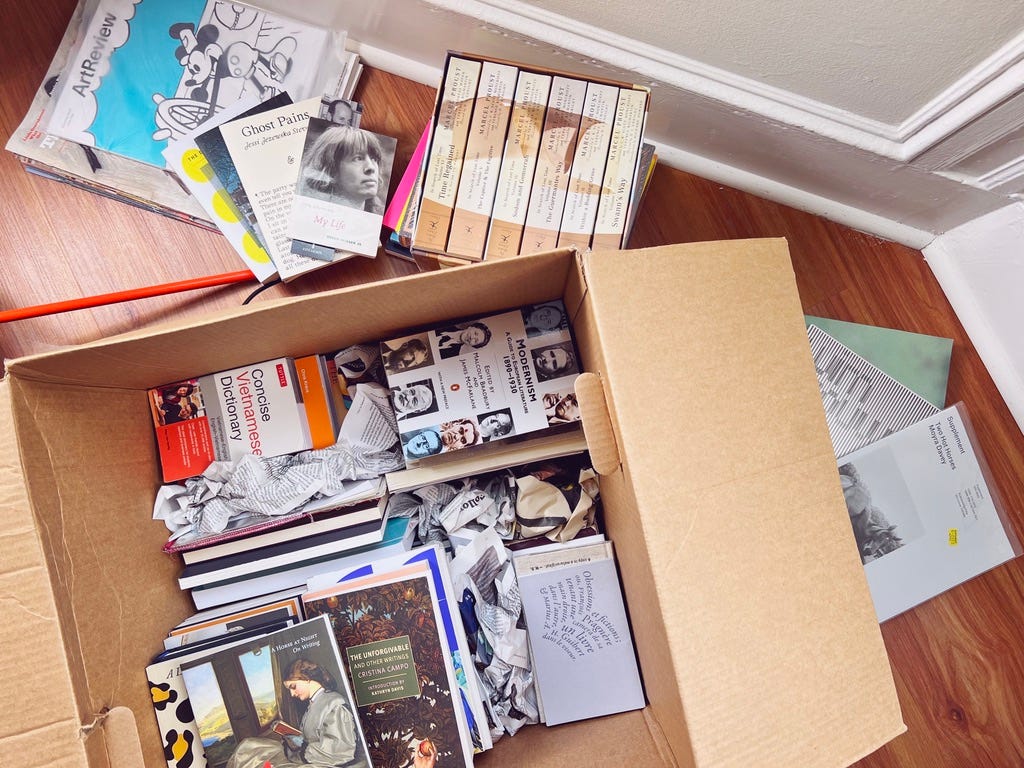
For Eco, who owned 50,000 books, the answer was no. Such a question, he wrote reprovingly, comes from “people who consider a bookshelf as a mere storage place…and do not think of the library as a working tool.” But he also observed, sympathetically, that:
Confronted by a vast array of books, anyone will be seized by the anguish of learning, and will inevitably lapse into asking the question that expresses his torment and his remorse.
Some readers, like Nassim Nicholas Taleb, refuse to feel tormented. In The Black Swan, the mathematician and essayist argued that “Read books are far less valuable than unread ones. The library should contain as much of what you do not know as your financial means, mortgage rates, and the currently tight real-estate market allow.”
Unfortunately, my means are substantially less than Taleb’s. In my London flatshare, I have books double-layered on my shelves and piled 2 feet high on my dresser. The windowsill is now a bookshelf, as is the floor. My unread New Directions paperbacks have laid claim to a corner of the bedroom, alongside unopened issues of the New York Review of Books. (In early October, I banned myself from buying more books. But Regina Marler’s review of a new Europa Editions novel led to a relapse; I convinced myself that I needed a copy of the 400-page novel Gabriële. I haven’t even read the first page.)
There’s a word for this, naturally: tsundoku (積ん読), for all the books you’ve purchased that pile up at home, unread. “My personal library,” the writer Kevin Mims confessed in the NYT, “is about one-tenth books I have read and nine-tenths tsundoku.” The problem seems pervasive enough for us to import tsundoku into the English language. “If only,” Jonathan Crow mused, “we can figure out a word to describe unread ebooks that languish on your Kindle. E‑tsundoku? Tsunkindle? Contemplate the matter for a while.”
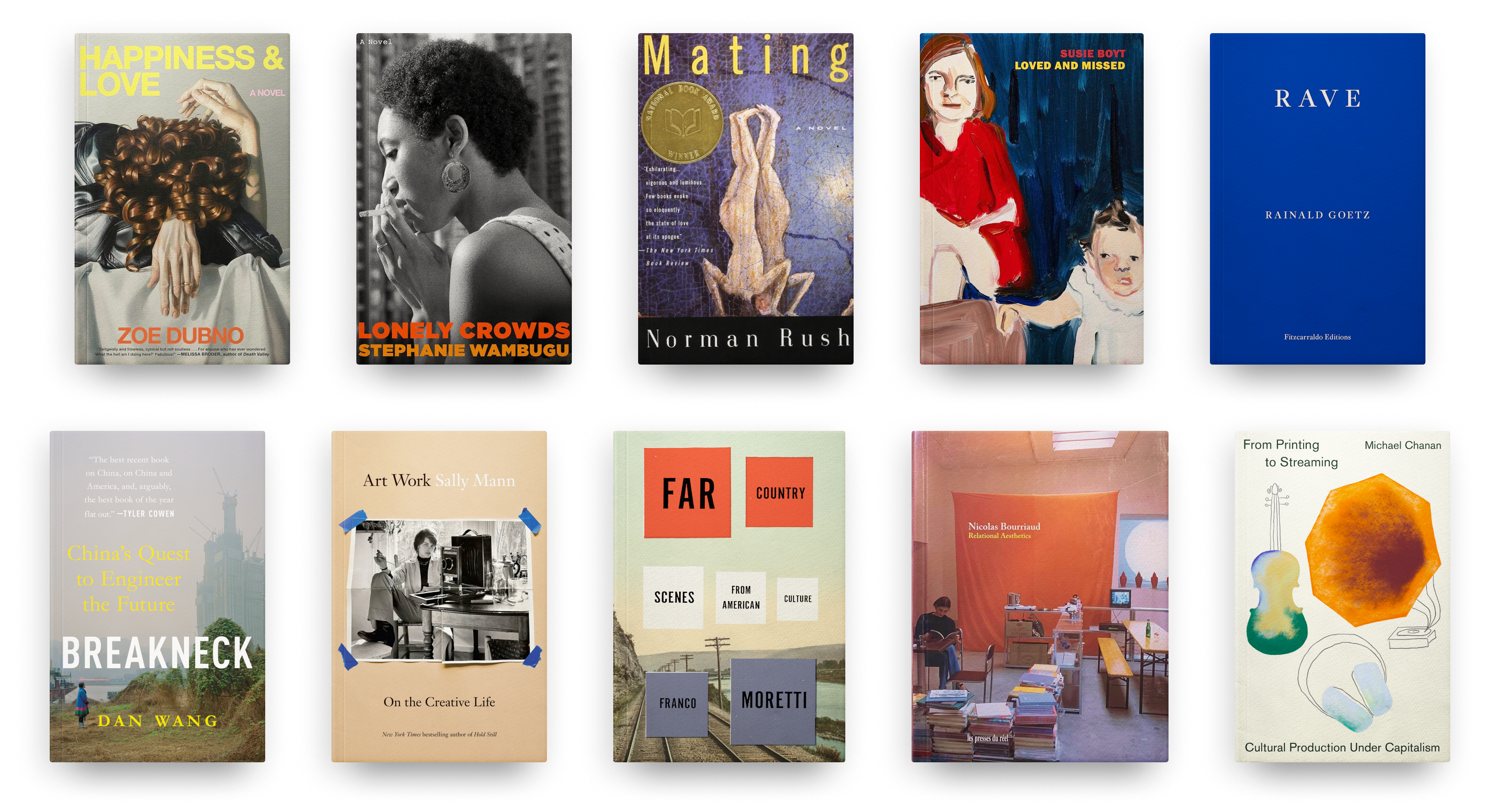
But finding the right portmanteau won’t solve my increasingly urgent problem: too many books in too small a space.1 For the past 2 months, I’ve been diligently reading through my tsundoku. The 20 books I finished include:
2 much-discussed debut novels (Zoe Dubno’s Happiness & Love; Stephanie Wambugu’s Lonely Crowds)
Every millennial’s favorite novel about falling in love (Norman Rush’s Mating)
An Italian sci-fi novella from the ‘60s about AI alignment
The year’s best nonfiction book about Chinese tech and culture
Art and literary criticism by Maggie Nelson, James Wood, and Franco Moretti
The most extraordinary…poem? novel? about a pastoral future after the collapse of cloud computing
A book of Marxist cultural theory that didn’t put me to sleep (unlike many in the genre…comment below if you’ve been personally victimized by the Verso catalogue)
And an upcoming book (which comes out on January 20!) about how to build a nonfiction writing career, by the literary agent Alia Hanna Habib (who represents Hanif Abdurraqib, Merve Emre, Lauren Oyler, and more)
Novels
Contemporary literature is good, I’m sorry to say
I’m always a bit mystified when people complain about the degraded state of the contemporary novel. Most new novels are inferior to the older ones—like Flaubert’s Madame Bovary (1856), Woolf’s To the Lighthouse (1927), or even Helen DeWitt’s The Last Samurai (2000). But does that mean that today’s novelists should stop writing? No! Because how else will we get the next Flaubert, Woolf, or DeWitt?
For this reason, I devote a lot of time to reading new novels—it’s exciting and invigorating to see what my contemporaries are doing.
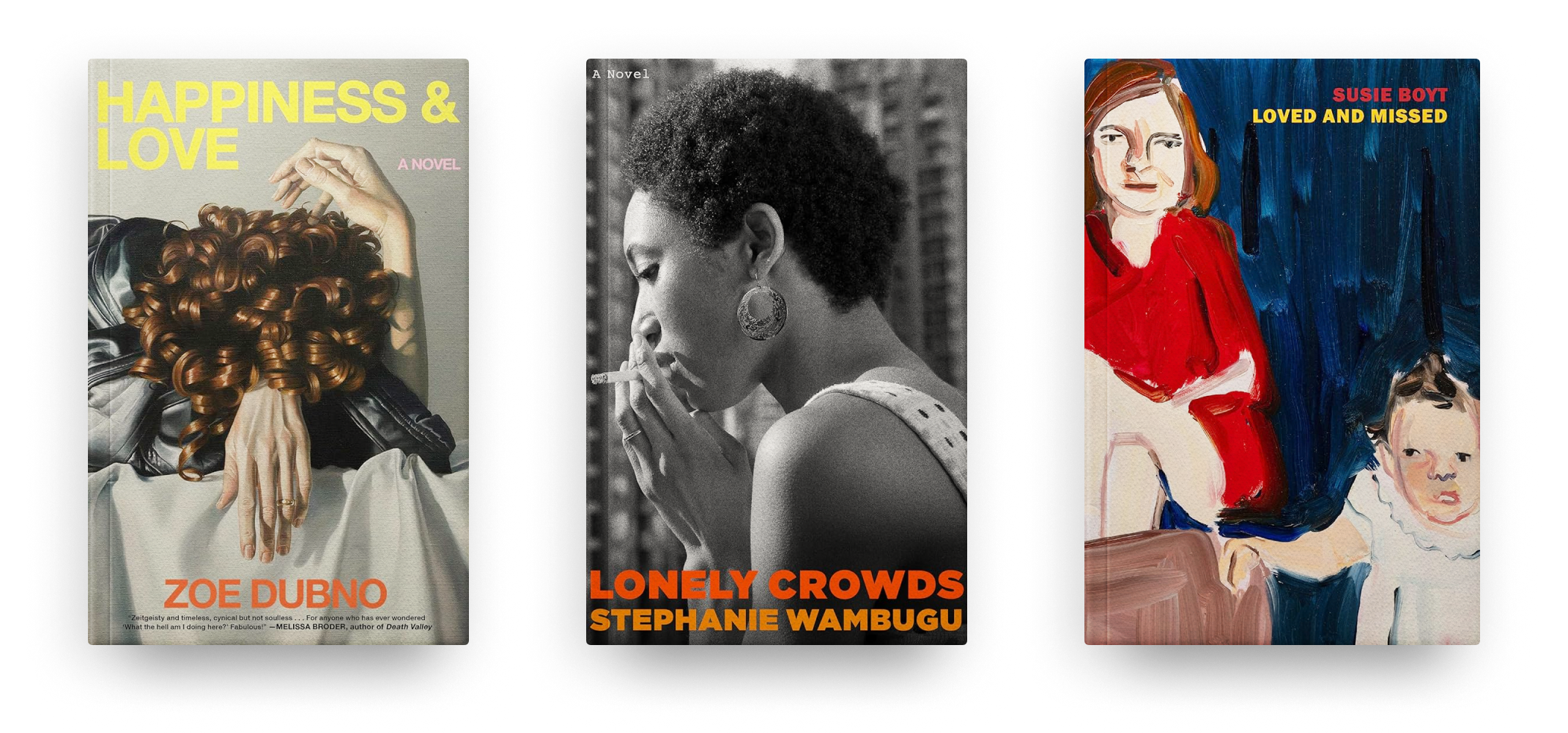
Zoe Dubno’s Happiness and Love (2025) has been described (both flatteringly and disparagingly) as a Dimes Square–adjacent novel, but a description like that is good for getting clicks, I don’t think it’s useful for readers.2 Here’s how I’d describe it: A young woman is reluctantly attending a dinner party of status-obsessed NYC artists, curators and pretenders. The dinner, which follows the funeral of a talented and beautiful actress (who never quite achieved it girl status), is meant to honor the actress—but the couple hosting the party have turned it into a networking event. As the evening progresses, the young woman bristles at the naked social climbing around her. As a young, idealistic ingenue, she idolized the people at this party; now, she engages in privately scathing character portraits of the shallow, status-obsessed people around her.
If you’re a fan of the Austrian writer Thomas Bernhard, you may recognize this as the plot of Woodcutters. Dubno’s novel is one of many literary remakes published this year: Vincenzo Latronico’s Perfection (reviewed in my June newsletter), is a remake of George Perec’s Things; and Olga Tokarczuk’s The Empusium (reviewed in January) is a remake of Thomas Mann’s The Magic Mountain. Nate West, who reviewed Dubno’s novel for The Baffler, wasn’t particularly impressed; he described it as “the Temu version of Woodcutters, cringingly imitative but in all areas wanting.”
But I can’t quite agree! Though I haven’t read Woodcutters, I loved Bernhard’s Old Masters and The Loser—and Dubno captures what I feel to be the essential, inimitable core of Bernhard’s style. In Happiness and Love, Dubno executes the classic Bernhardian cynicism in an exhilarating way—but she also showcases, too, the most compelling part of Bernhard: a certain vulnerability and awe in the face of love, art, and the finiteness of our lives. What I learned, from reading Bernhard’s Old Masters (about a music critic meeting with a recently widowed friend) and The Loser (about a once-promising pianist intimidated by the genius of Glenn Gould), is that vicious cynicism can happen only when one is, at the core, a disappointed idealist—and one recognizes that reality is falling short of your most cherished ideals. What the young woman of Happiness and Love wants, I think, is a world where the people who claim to care about art actually care about art—not status, not money, not clout, not scenes. She wants mentors she can believe in. She wants people who are more than just a showy, status-conscious surface. That’s how I read Dubno’s book, at least. And I loved it.3
I also read Stephanie Wambugu’s Lonely Crowds (2025), a coming-of-age novel about Ruth and Maria—two young black girls who befriend each other at a mostly-white Catholic school, attend Bard together, and then move to NYC to pursue artistic careers. It is, naturally, a novel about fraught female friendship: Ruth and Maria are almost codependently intertwined as children, and as Ruth narrates their adolescent and adult years, it’s clear that Ruth struggles to individuate herself from Maria—who she sees as more capable, confident, and strikingly beautiful.
This may sound like every other literary fiction novel about art, envy, female friendship, and class. (Seriously: do they publish any other kinds of novels?) But Wambugu’s is one of the few I’ve actually finished, in part because it’s astonishingly well-written. A lot of literary fiction drags; the novels are too impressed with their own intelligence, and there’s an over-abundance of introspective, interior passages—compared to passages where characters act and actually do things. But that’s not the case with Wambugu’s writing; her characters have a kind of mobility and aliveness in their opinions that makes even internal reflection very dynamic:
And I was propelled forwards, too, by the feeling that these characters were fascinatingly obscure to me. Ruth, Maria, and the friends and lovers they have are clearly powered by strong, impulsive desires—which lead them to do (and say) things that seem shockingly outré. This helps the novel propel forward with great velocity—because you, the reader, can’t quite understand the characters, but you desperately want to!
One of the earliest scenes in Lonely Crowds takes place in Ruth’s adult life, where you learn that she is already a professor at an esteemed liberal arts college; that she has a solo painting show opening that evening in NYC—and what you see her do, in her moment of triumph, is flee the opening and crawl into bed:
I knew that at that very moment, my gallerist was still back at the opening, working the room and securing a legacy for me, while I wandered the streets like a person without a name. Maybe I had been acting erratically, since everywhere I went people asked me if I was feeling okay, as you might ask an insane person as you led them gently back to a shared reality…
Up in my room, I checked my cellphone and saw that my husband had called and texted. As had my gallerist. He was throwing an after-party at a nearby bar in my honor. A big party, open bar. Lots of fun. Every last one of my paintings sold. It was cause for celebration. I was the woman of the hour. Everyone wanted to see me. Did I want them to order for me? Did I want coke? Ketamine? Where was I? Was everything alright? I undressed and then I swallowed two small yellow pills, antihistamines for sleep, washed down with a cup of tap water. I said a quick prayer, for what, I didn’t know. I started the story from the beginning before falling asleep.
At this point, the story lurches into Ruth’s early childhood: meeting Maria (who Ruth spends the rest of the book defining herself with and against), her early attempts at becoming artists, and Maria’s early success as an It Girl artist—while Ruth trudges along, like Maria’s imitative shadow.
Wambugu writes with exceptional poise and total control; the novel is almost flawlessly paced. (Ochuko Akpovbovbo and Pandora Sykes agree; you can read their conversation about Lonely Crowds here.) And it’s an insightful portrait of trying to “make it” in the art world, status-consciousness and envy, and a friendship where admiration and sexual interest are tangled together.
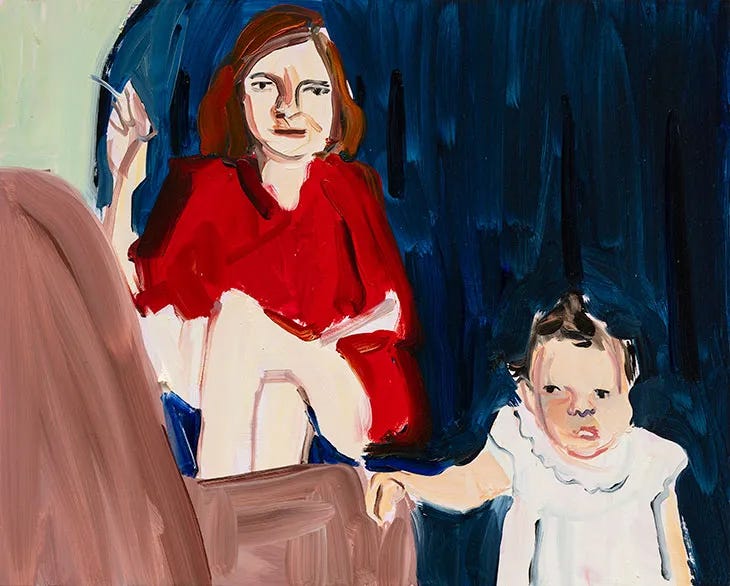
The third recent-ish novel I read was Susie Boyt’s Loved and Missed (2021). It’s Boyt’s 7th novel—and worth noting that she’s the daughter of the painter Lucian Freud, and the great-granddaughter of the one and only Sigmund Freud. I’ve been meaning to read this ever since Loré Yessuff recommended it to me—along with the poet Ariel Yelen’s I Was Working, which I wrote about in my January newsletter:

Loved and Missed is about Ruth, a schoolteacher and single mother in London whose daughter, Eleanor, leaves school at 15 and becomes a heroin addict. I’m describing it bluntly, but the pain that Ruth feels is often that uncompromisingly blunt—she feels “completely invalidated as a mother,” tormented by her failure and riven with pain at Eleanor’s fate:
I was at sea with her and without her, out of my depth, famished, debased and drowning so it was odd to be hailed at school as a champion of the suffering teen. It’s not unusual to lead a double life, certainly, but it was a bit grotesque to be quite so good at things and quite so bad…
Neglect your children and they will be obsessed with you for life – I read that once – but what about when they neglected you?
After Eleanor gets pregnant, Ruth ends up temporarily—and then permanently—taking care of Eleanor’s daughter, Lily. The relationship between grandmother and granddaughter takes up most of the novel; it offers Ruth a chance to be a mother again, to do things over, to try and protect Lily from the contaminating shame and grime of Eleanor’s life, as she continues to struggle with addiction and homelessness. Caring for Lily makes Ruth’s life lighter: “It wasn’t a life in the shadows any more – instead exhilaration, free-running cheer that had no basis of anxiety. Hope, I suppose it was.”
But this is a novel about adult life, which means it’s a novel about the wavering reparations we can make for the past—the incomplete, inadequate attempts we make to square ourselves with early traumas and complex forms of abandonment. I cried profusely while reading Loved and Missed, because the core problem of the novel—Eleanor’s addiction, and how it warps her mother and daughter’s life—is never really resolved. All that Ruth and Lily can do is orient themselves gingerly around it and try to cope with it. “They emerge,” the critic Jane Hu wrote in her review for the New Yorker,
as people in desperate want—for a daughter, in Ruth’s case; a mother, in Lily’s—who find a way to make do without what they lack.
It’s a novel that dismantles whatever mood you’re in and replaces it with the novel’s own internal weather—inclement and stormy and moving and, in the final scenes, graceful. It’s worth reading. You’ll probably tear up a little (a lot).
The hazards of looking for intelligent, romantic love
For many years, I read exclusively nonfiction—a common stance for Silicon Valley tech workers who feel that factual, objective knowledge is more useful than the slippery subjectivities of the novel. What changed? And how to catalyze this change in other people?
A few months ago, the writer Klara Feenstra and I were trying to come up with a list of gateway novels—ones we’d recommend to tech people who are skeptical of fiction. She suggested Norman Rush’s Mating (1991). I told her I’d never read it. She told me it was one of the best, if not the best, depictions of love written by a man.
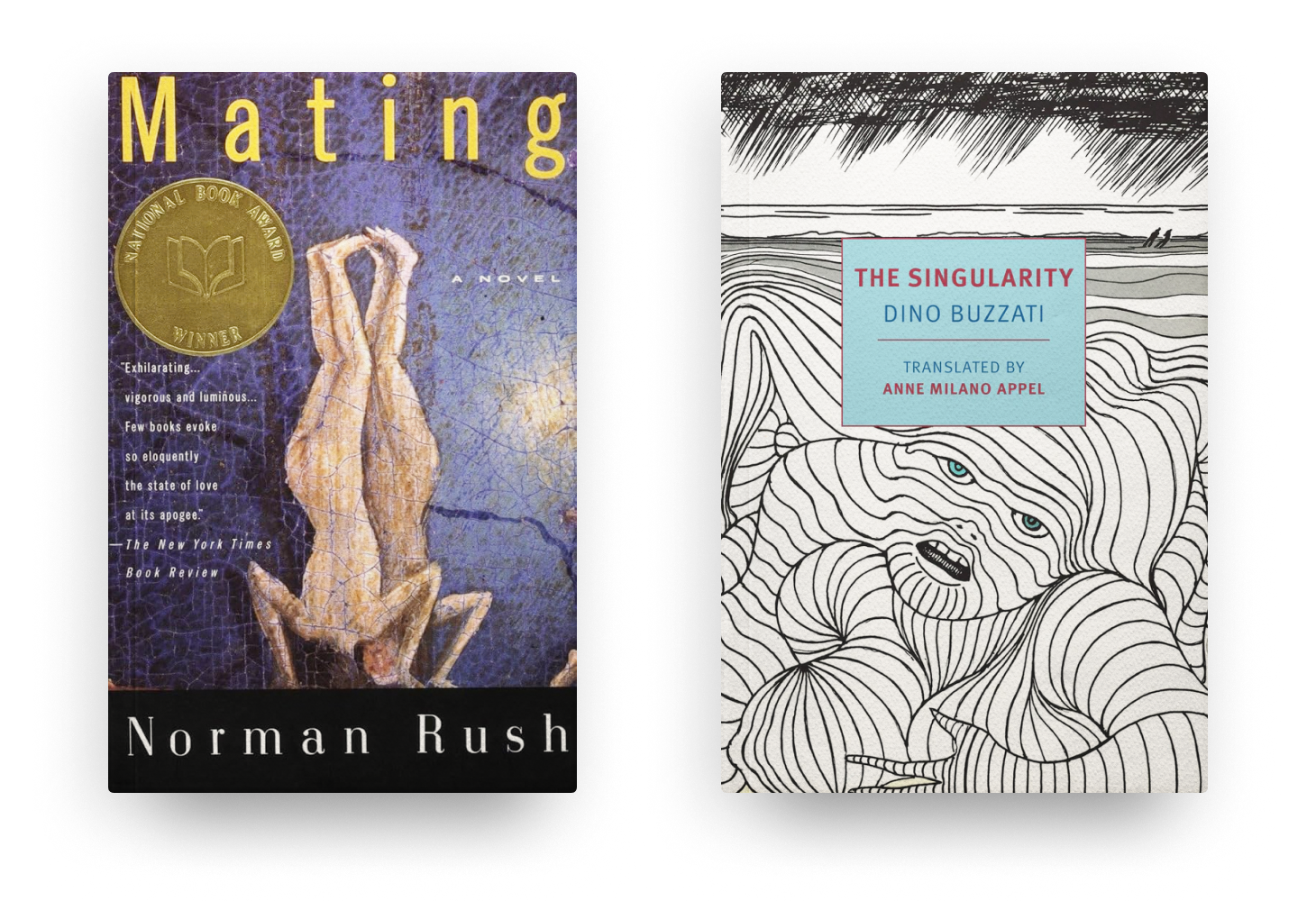
Mating has something of a cult following—but mostly among literary people, for now. (The software engineers are still stuck on Seeing Like a State.) In 2023, the NYT Styles editor Marie Solis asked, “Why is everyone reading Mating?” and came up with one possible answer: it’s the rare novel that seems to believe in love—and heterosexual love, even!
While love remains among the greatest subjects for fiction writers, heterosexual love is, well, perhaps a bit passé — particularly the notion that a woman might devote so much energy to landing a man. In Mating, the narrator sets off on a harrowing journey across the desert to get hers.
The novel follows a 32-year-old American PhD student who abandons her anthropology dissertation to pursue a celebrated, reclusive star of her field: Nelson Denoon. And it’s set in Botswana, where the author was co-director of the Peace Corps for many years—along with his wife, Elsa. In an interview with the Paris Review, Rush says:
The real model for the narrator—I’ve hardly tried to hide this—was Elsa. Her fearlessness of thought; her determination, almost to the point of parody, not to be deluded, tricked, deceived; her comic sense of life, and a totally empirical kind of intelligence, as opposed to Denoon’s more theoretical intelligence. She’s pretty much a straight lift.
I confess that I struggled with Mating. The novel is so highly praised that it arrived into my life over-praised. I expected an impeccably written and incorrigibly funny novel—and I got that—but I also expected it to be a depiction of the ideal, the aspirational romance. Instead, what I got was a romance between two very particular, prickly people. Although I was overwhelmed by the sheer virtuosity of Rush’s writing, I also had complicated feelings about the couple it depicted. I didn’t know if I was in love with Mating’s version of love.
But another friend—Wendy Liu—had recommended the novel to me as well, along with Benjamin Kunkel’s LRB essay on Rush, which discusses the particular form of love that Rush depicts in Mating and his other, later novels. And it was this essay, more than anything else, that endeared me to the book. Because I recognized, in Kunkel’s description, the kind of love I’d like to have:
In Subtle Bodies, Nina is attracted to Ned because he she finds him ‘verbal looking’. The intuition is correct, about all of Rush’s inwardly and outwardly talkative people…[which] is connected with Rush’s representation of mature love among educated people. Marriage is a long conversation, Nietzsche said; in his case it was a guess. In Rush, it is simply a fact. ‘He loved talking to her, the sheer talking, whatever the subject was.’ Rush’s husbands and wives enjoy telling each other much – of course, never all – of what’s on their minds.
Love as an ongoing conversation, an infinite game: that’s what Mating is about. And love as something that can occur between two imperfect people, too—including one person who is simultaneously “a sort of Jesus” and “a complete asshole.” (Kunkel is referring to a character in a different Rush story, but it applies well to the man in Mating—and to a number of Silicon Valley men too, I think.)
‘A sort of Jesus’ and ‘a complete asshole’ captures something of the tonality of love in Rush. Romantic love, prolonged past infatuation, ridicules the idealisation of the other that will have inspired it but also permits and, if the romance is to continue with the love, requires another sort of admiration, more solid because more sober and – to use a term basic to the criticism of fiction – realistic. Romanticism in collaboration with realism, ongoing courtship plus established intimacy, facing the truth of facts without ignoring the truth of aspirations: formulas like these give an idea of the image of mature love in Rush. And he has a similar relationship to his characters, relentlessly exposing their every aspect, including the petty, ignoble and ugly ones, without ceasing to cherish them or at least to give them a chance at regaining the paradise, as in Rush it always is, of married love.
The paradise of an intelligent, informed love—that’s also the subject of Dino Buzzati’s The Singularity (1960), an Italian sci-fi novella translated by Anne Milano Appel. I’ve had this on my shelf (well, it’s now on my floor) since June of last year, when I received it as part of the NYRB Classics Book Club.
I wrote about 3 great monthly book subscriptions in—

The NYRB excels in finding older books that address contemporary concerns. The Singularity is an appealingly readable mystery that follows Ermano Ismani, a 43-year old university professor who is asked to join a mysterious research project funded by the Ministry of Defense.
Ermano—timid, sedentary, and cautious—doesn’t know whether he’ll accept, but his cheerfully practical wife, Elsa (“an incalculable blessing for Ismani, who was so unprepared for practical life and concerned about every trifling detail”) encourages him to. The couple relocate to a secluded research complex, where they meet the other researchers. The project, it turns out, is an immense artificial brain.
There’s a complicating factor: one of the other researchers, heartbroken at losing his wife, has tried to imbue the AI with the personality of the deceased woman. The usual problems show up: how can they tell if the AI is aligned with their interests? Should the researchers try to achieve outcomes related to national security, or mathematical research, or matters of the heart? Is the AI lying? Is it pretending to be aligned with the researchers and their goals? And if the AI goes rogue…will its creators be willing to shut it down in order to save a human life?
The Singularity is excellently paced, but it feels more like a fairy tale than science fiction. I found it charming but not exceptional—but it’s interesting to see how contemporary AI debates are explored in this decades-old novella.
Nonfiction
How to do great work
There are obvious reasons to read Dan Wang’s Breakneck: China’s Quest to Engineer the Future (2025), a bestselling book about China’s quest for scientific, technological, and economic dominance. Maybe you’d like to understand how China went from the Western world’s outsourced sweatshop to the world’s most advanced solar panel and electric vehicle manufacturer. Or you’d like a less Sinophobic, more informed perspective on the government’s relentless attempts at population control, from the one-child policy to zero-COVID.
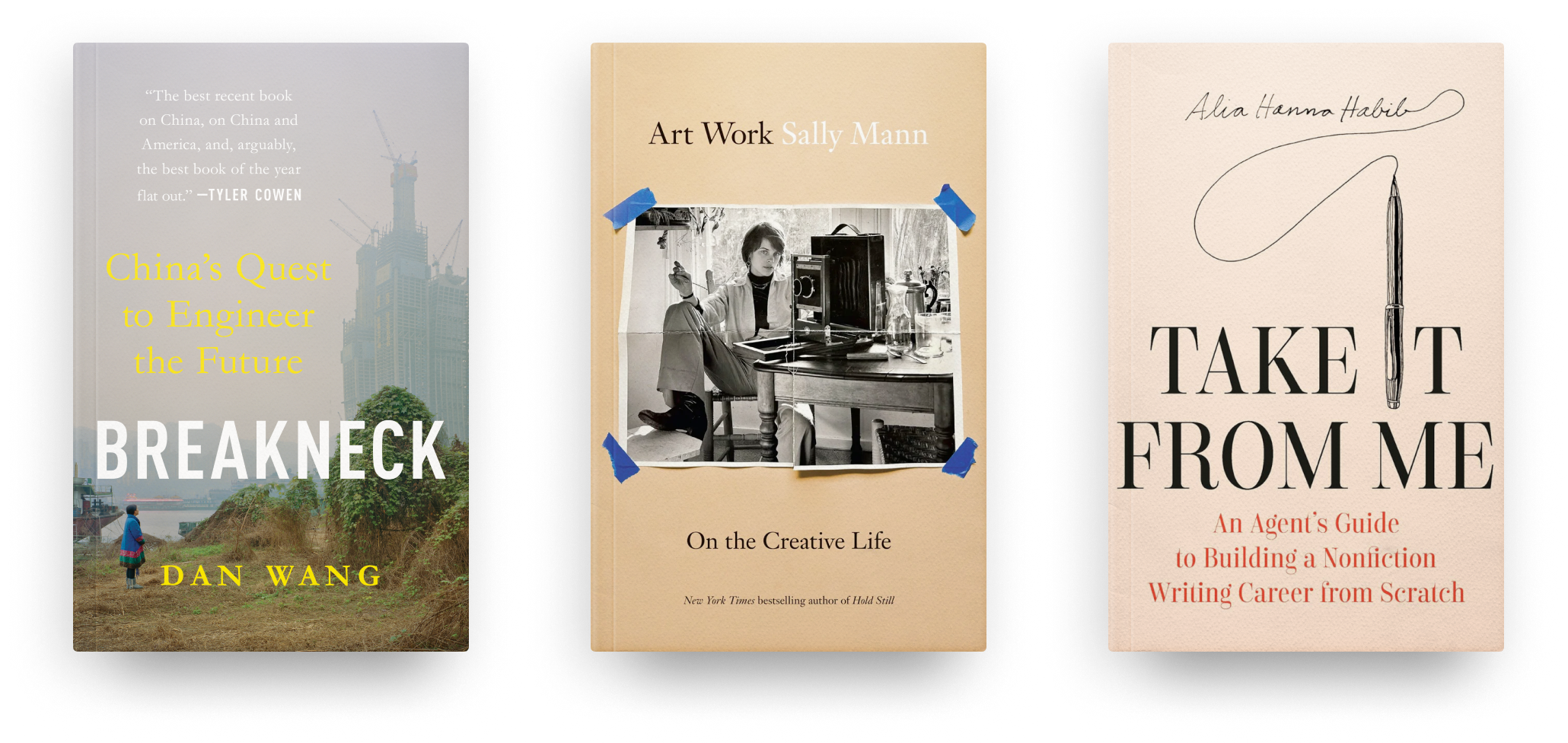
But my reason for reading Breakneck? There just aren’t that many great nonfiction books out there! And not many that are easy to read, intellectually serious, narrated in the first person (but not trying to start a personality cult), and—the most useful quality for any nonfiction book—full of portable intellectual tools. By that, I mean: ideas which help you reframe other parts of the world and understand them more deeply.
One of the most portable and highly mimetic ideas in Breakneck is Wang’s characterization of China as an “engineering society” compared to America’s “lawyerly society,” which he uses to explain China’s technological gains compared to America’s sclerotic, slow-moving infrastructural projects. But my favorite idea in Wang’s book is where he talks about process knowledge:
When we talk about technology, we should really distinguish between three things. First, technology means tools…Second, technology means explicit instruction…Third and most important, technology is process knowledge. That is the proficiency gained from practical experience, which isn’t easily communicated.
Wang uses the concept of process knowledge to argue that—when America outsourced manufacturing to China—American countries lost technical proficiency, while China gained the knowledge to not just execute American plans, but innovate and develop new technologies:
Process knowledge is hard to measure because it exists mostly in people’s heads and the pattern of their relationships to other technical workers. We tend to refer to these intangibles as know-how, institutional memory, or tacit knowledge. They are embodied by an experienced workforce like Shenzhen’s…
Shenzhen is a community of engineering practice where factory owners, skilled engineers, entrepreneurs, investors, and researchers mix with the world’s most experienced workforce at producing high-end electronics. Silicon Valley used to be like this too, but now it lacks a critical link in the chain—the manufacturing workforce. The value of these communities of engineering practice is greater than any single company or engineer.
What makes Wang’s concept of process knowledge so interesting is how he argues it, too—by referencing how the Ise Jingu shrine, first built in 690 AD, has been rebuilt every 20 years. By continually rebuilding the shrine, the caretakers are constantly renewing the craft knowledge and expertise involved—ensuring that it will be transmitted across generations.
It’s an unusual and striking comparison to make when writing about contemporary technologies, like cellphones and solar panels. And it was this reference to the Ise shrine that made me so impressed with Wang’s book. In my podcast episode with Jasmine Sun, I made a comment that, for writers, the references you draw upon are an essential part of your style. Breakneck is an exceptionally good tech/business book precisely because Wang’s references are so wide-ranging.

I also read the photographer Sally Mann’s Art Work: On the Creative Life, after receiving a copy from a friend. (In addition to self-inflicted tsundoku, I also suffer from generous friends and socially-inflicted unread books!) Over the summer, I was corresponding with the art critic Natalie Weis (who I met through writing this newsletter!) and we ended up meeting in London during Frieze Week. Natalie had just filed her review of Art Work for Hyperallergic, which perfectly describes the delightfully strange range of the book:
Artists in need of instruction and inspiration have no shortage of books to consult, from Julia Cameron’s The Artist’s Way to Austin Kleon’s Steal Like An Artist or Rick Rubin’s The Creative Act. Each volume offers dozens of cheerful directives that live somewhere between koan and bromide, encouraging readers to “Let yourself play” (Cameron), “Use your hands” (Kleon), and “Look inward” (Rubin).
In her new book, Art Work: On the Creative Life, Sally Mann is perhaps the first to provide some truly practical advice; nestled among suggestions for dealing with rejection, distraction, and perfectionism is her 1971 handwritten list of home remedies: “You will note about halfway down that intestinal worms are to be treated with raw garlic and rice,” she states, “but of course you clever young people know I was wrong about that: the best treatment for worms—pinworms anyway—is diatomaceous earth.”
But of course.
Art Work is an ideal read for anyone trying to pursue a creative practice. It exhorts artists, writers, photographers, and others to pursue the usual virtues—patience, perseverance, technical excellence, self-knowledge—without becoming too sanctimonious. One of the most useful takeaways from Art Work is the importance of artistic friendships: Mann describes her decades-long dialogue with Ted Orland, a fellow photographer who was Ansel Adams’s assistant and the author of one of the great artistic self-help books, Art & Fear. (I plan to reread Orland’s book in December.) Orland was a technical mentor to Mann, and a constant source of encouragement:
He…began to teach me what photography was really about: pushing the limits, having fun. Doing stuff that the Kodak guidebook said not to do. That first night after dinner, we all went out into the grasslands and Ted set up a camera with Polaroid 4 × 5 film to take a picture by moonlight…
He showed me things about the view camera and about printing that I use to this day. He introduced me to Ansel, who appeared wearing a large apron, his chemical-stained fingers holding a bulbous goblet of red wine. I adored him on sight. Soon we were both drinking wine and looking at my pictures, 5 × 7–inch contact prints mounted on cheap brown board, about which he was scrupulously kind. Ansel was welcoming, he was encouraging, he gave me information and hired me to be an assistant for the next year, but it was Ted who really gave me my way forward.
Mann describes the years that she and Orland spent writing to each other, encouraging each other, urging each other onwards. After reading Mann’s book, I was thinking of all the friends I text and call and speak to when I’m in the middle of a writing draft—when I’m demoralized, when I’m excited—and how foundational these friendships are. As Mann writes,
Years ago, my friend Ted Orland…used to sign his books “Your Fellow Traveler, Ted,” and that phrase was telling. For Ted—and, I hope, my readers—the important thing was that we are all on the same creative road together, however far apart we are in other ways. But we can be brought together by the how; how those of us well along in our careers got there, how our lives racked up the miles. It is about more than technique or practice or even, yes, hard work. It is about how you live your life, because the life you lead is your art and the art you make is your life…
This book is written by an old woman primarily for young artists and writers, with the vain, and vainglorious, hope that some of it will make a difference in the way you organize (yes, I did say organize) your creative practice.
If your artistic ambitions involve writing a book—a nonfiction book like Wang’s Breakneck, perhaps—then you might enjoy the literary agent Alia Hanna Habib’s Take It from Me: An Agent’s Guide to Building a Nonfiction Writing Career from Scratch. Habib’s book comes out next January, but after reading several of Habib’s engaging and wise newsletters—on finishing your drafts, finding an agent (or becoming one), and starting a Substack—I wanted more of her advice.
So I emailed a publicity manager at Penguin, who sent me a PDF of Habib’s book. Take It from Me is that rare and wonderful book that addresses both commercial and artistic concerns. Habib writes about the strategic and pecuniary aspects of being a writer (bylines, credentials, contracts, and getting paid)—but she clearly loves literature, and loves the writers she represents, and loves the entire process of shepherding great work into the world. Early on, Habib writes:
I emphasize guiding as much as I do gatekeeping, in large part because I remember what it is like to be on the other side of a gate, as well as how many times earlier in my career I was desperate for clarification, context, and guidance that was hard to find.
Take It from Me showcases the different careers that nonfiction writers can have. Habib writes about Dorothy Brown, a law professor whose book The Whiteness of Wealth analyzes racial bias in American tax policy; she also writes about the poet and essayist Hanif Abdurraqib, who began his career writing about music for zines and other DIY publications, and later became a MacArthur fellow.
The book is partly an instruction manual (with practical advice for writing a book proposal—with examples!—and finding an agent) and partly a motivational text. It’s a generous and encouraging book; if you have a nonfiction writer in your life, this would be an excellent gift to give them. And the gift you’re giving isn’t just a book—it’s also a way to show them that you trust and believe in their work.
Literary and art criticism
The other theme in my October and November reading: more criticism. I’ve been writing a lot about the state of criticism in 2025, in my newsletter—

—and for Asterisk Magazine’s Books issue, where I describe the influential, countercultural publication The Village Voice as “the Bell Labs of cultural criticism.”
But in the last few weeks, I’ve been reading the work of some of the best critics of the last few decades: Maggie Nelson, James Wood, and Franco Moretti.
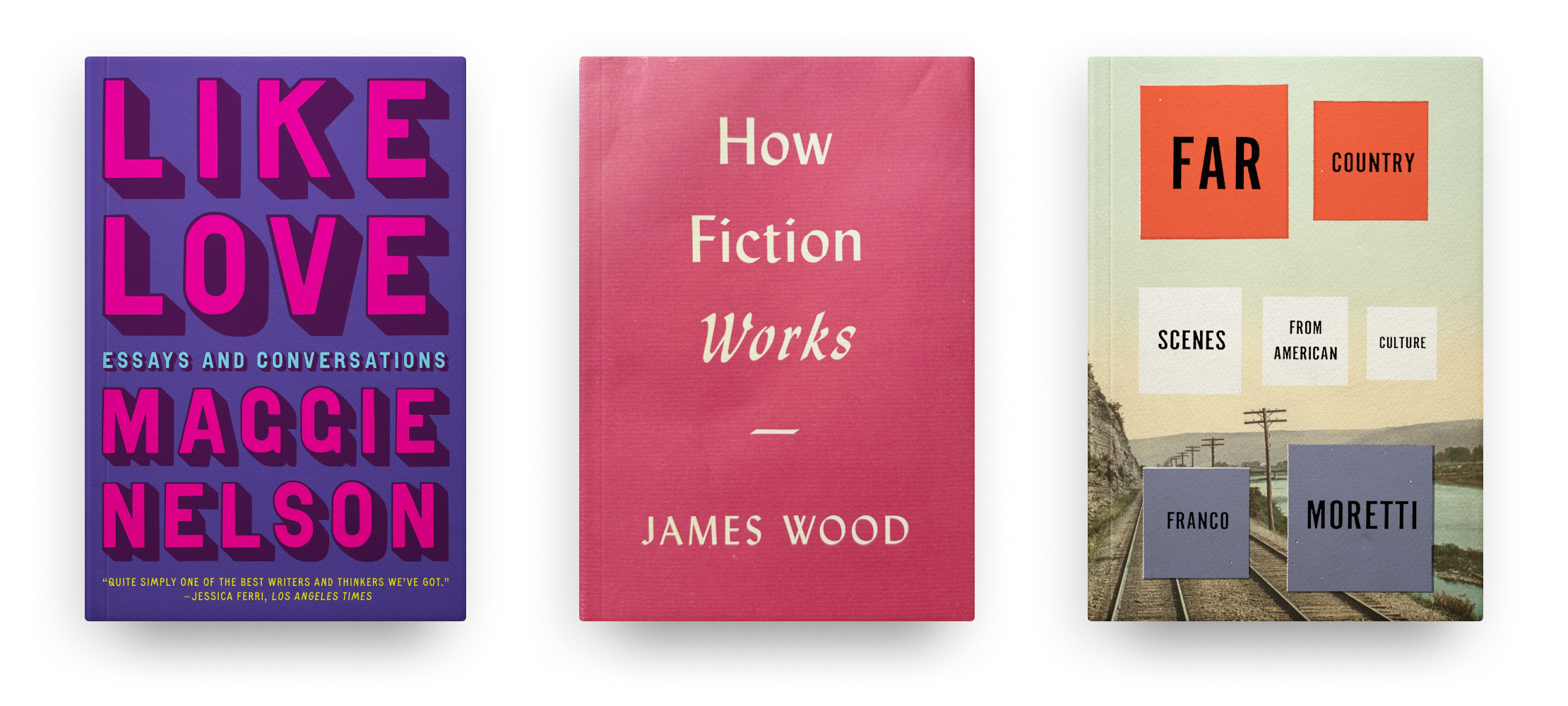
Maggie Nelson popularized a style of nonfiction writing that nearly every young woman on Substack (myself included) is practicing, in one form of another. It’s an elegant hybrid of memoir–criticism–theory that other writers, often published by Semiotext(e), employ—but it was Nelson’s books that introduced me, and many others, to this style. She’s best known for Bluets and The Argonauts, both breakout books in categories that seemed too avant-garde, too abstruse, to ever “break out.”
Maggie Nelson’s Like Love: Essays and Conversations (2024) has been sitting on my shelf since last June, when my friend Kiran and I attended her talk at City Arts and Lectures in San Francisco. (You can listen to a recording here.) Like Love is a collection of twenty-ish years of Nelson’s writing: art criticism, literary criticism, conversations with musicians (Bjork) and writers, like Wayne Koestenbaum—who once praised Nelson’s writing by saying:
She’s reaching with every paragraph into all the coffers of her reading and conversation…There’s a hunger for citation, and a generosity and inclusiveness about how much of other people’s thinking she would acknowledge and make room for in her work. It’s very public work.
Nelson’s writing is referentially dense, but she retains an intimacy and warmth that I really admire—it’s a tactic I’d like to steal (as so many have stolen from Nelson’s sublime style). She’s disarmingly conversational in her essay about the theorist and poet Fred Moten (first published in 4Columns), and openly admiring in her conversation with the feminist critic Jacqueline Rose.
And of course I loved her essay on the late, great Eve Kokofsky Sedgwick’s essay collection, The Weather in Proust, which was first published in LARB. (If Proust is mentioned in the first 20 pages of a book, I’m almost guaranteed to finish it! Other books in this category: Jacqueline Harpman’s I Who Have Never Known Men, Daša Drndić’s EEG—where a character is likened, disparagingly, to Madame Verdurin—and Sally Mann’s Art Work The nice thing about reading Proust is that it serves as a warm introduction to other books—like going to a party alone, but being on intimate terms with the most famous person there, and therefore emboldened to speak to any stranger present.)
But I digress. I also read the literary critic James Wood’s How Fiction Works (where Proust also makes an appearance, but only on page 47). Wood is, perhaps, one of the most famous literary critics of our time—first at The Guardian, then The New Republic (where he famously inveighed against the “hysterical realism” of contemporary novels), and then the New Yorker.
It’s very clear, when you read How Fiction Works, how much Wood loves literature—with a kind of reverential attentiveness that makes you want to love it as much as Wood does. The book is primarily concerned with characterizing how realist fiction works—and how a realistic story, characters, and setting are constructed. And he beautifully explains some technical terms, like what “free indirect style” is:
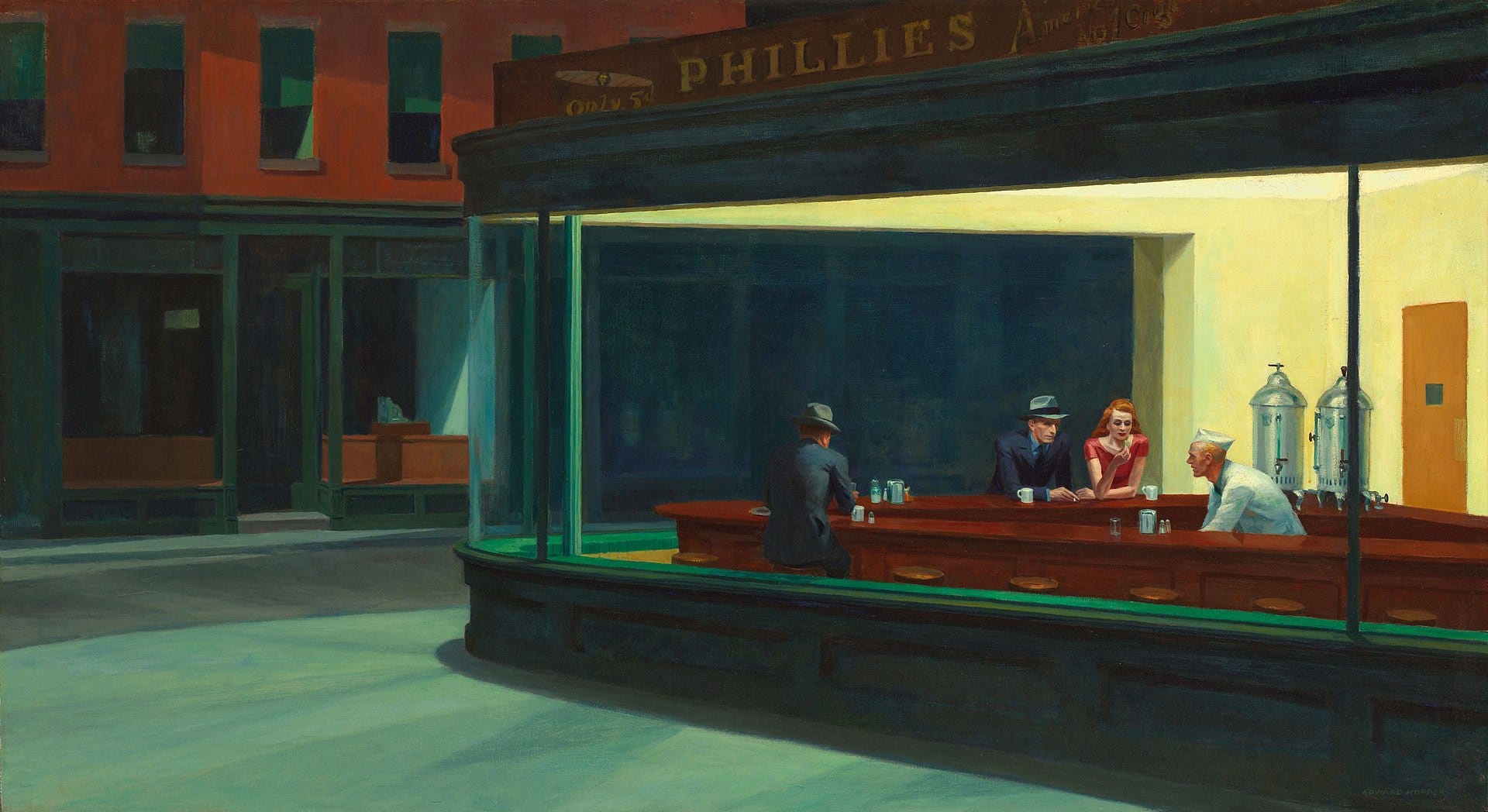
After Wood, I plucked—from a particularly towering tsundoku—a copy of the literary critic and Stanford professor Franco Moretti’s Far Country: Scenes from American Culture, which I bought in 2024 when it was discounted at Dog Eared Books in SF. At risk of encouraging bad (book-buying) behavior…I’m glad I didn’t read it until now! I’ve read more books, seen more films, and looked at more art since I first bought the book—so there’s more I can learn from Moretti’s class-lectures-turned-essays, which juxtapose different works from the same category. The first lecture compares and contrasts two poets, Walt Whitman and Charles Baudelaire. A later lecture compares Vermeer’s 17th-century portraits of Dutch life and the 20th-century urban anomie in Edward Hopper’s paintings.
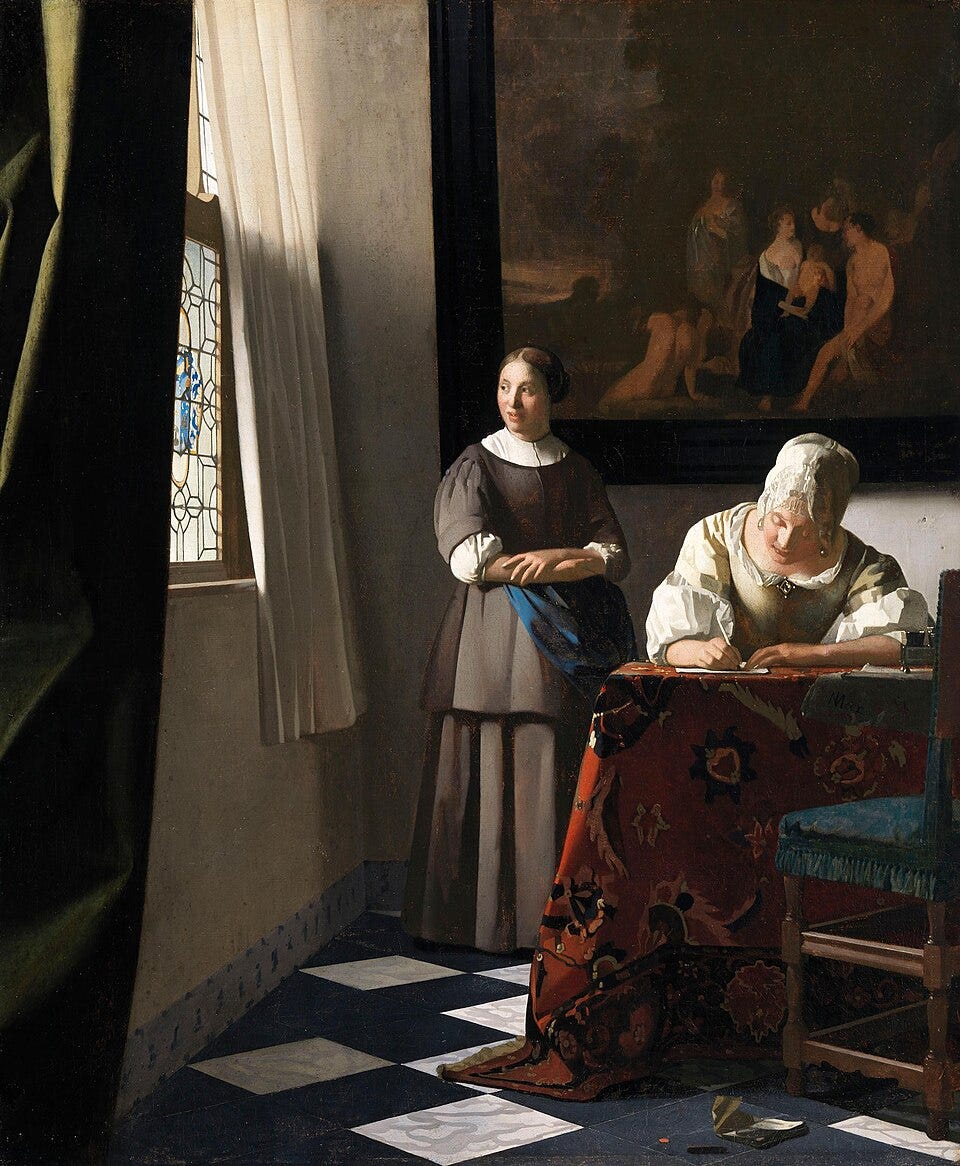
“People are often on their own, in Vermeer; lonely, never,” Moretti writes—unlike the people in Edward Hopper’s paintings:
Edward Hopper’s world is at once a distant echo of Vermeer’s, and its point-by-point reversal. In his twentieth-century America, the bright everyday of early modern Holland returns to the old connotations of the term: the everyday as a colorless succession of blank, uneventful days…
Vermeer’s people were always doing something: if they weren’t usually working in the proper sense of the word…they were reading, writing, listening, playing the lute, trying on a necklace. Active. Hopper’s figures, even when nominally at work…are so stiff, they seem to have been hypnotized. Not action, but its suspension is his great theme.
I got what I wanted out of Maggie Nelson, James Wood, and Franco Moretti: an invigorating reminder of what great criticism is like. They’re excellent examples of the theoretically precise, historically rich, and accessible writing I strive to do.
A historical and theoretical turn
Speaking of which: halfway through November, I began to feel that I needed more theoretical frameworks and historical context at my disposal—especially when writing about art:

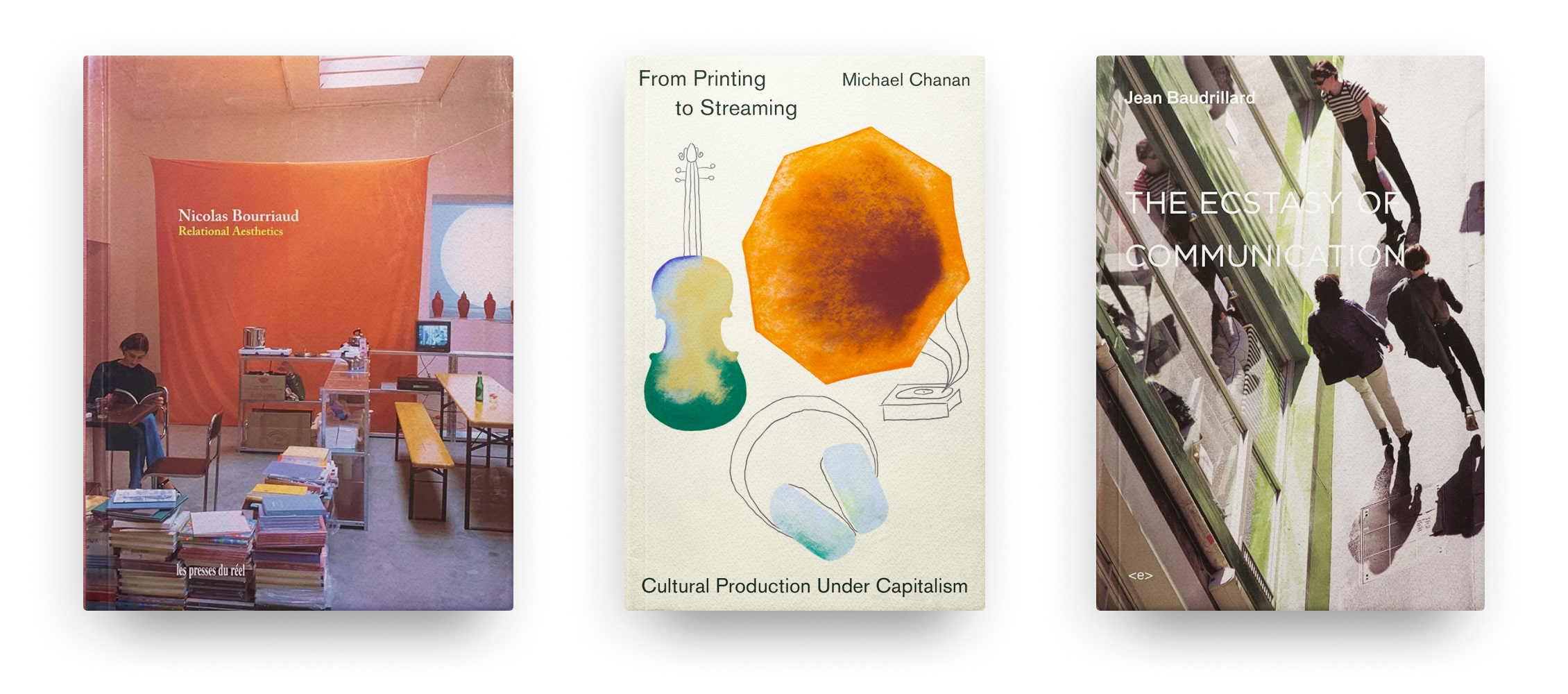
So I unearthed my secondhand copy of Nicolas Bourriaud’s Relational Aesthetics, which I bought in December 2023, a week before I sent my first newsletter. I’ve brought Bourriaud’s book with me across 4 different apartments and 2 continents—unread, obviously—but this elaborate estrangement from my own books had to end. I spent a week commuting to work with Bourriard and finished it on the Central line.
Nicolas Bourriaud is a French art critic who cofounded the Palais de Tokyo, and later curated contemporary art at the Tate Britain. In Relational Aesthetics, published in 1998 (and translated into English in 2002), Bourriaud describes a new approach to contemporary art, using artworks by Rirkit Tiravanija, Gabriel Orozco, Félix-Gonzales Torres, and others as examples.
I wrote about Gabriel Orozco’s sculpture, Kiss of the Egg, in—

—and I wrote about Félix-Gonzales Torres and art during the AIDS crisis in—

Bourriaud calls this approach “relational art,” which he defines as. Relational artists, he notes, “are not connected together by any style, theme or iconography.” What they share, instead, is “the same practical and theoretical horizon: the sphere of inter-human relationships.” Their artworks:
involve methods of social exchange, interactivity with the viewer within the aesthetic experience being offered to him/her, and the various communication processes, in their tangible dimension as tools serving to link individuals and human groups together…
They are all working within what we might call the relational sphere, which is to today’s art what mass production was to Pop Art and Minimal Art.
Bourriaud’s book helped me place contemporary art trends in a longer historical lineage. And I enjoyed, too, the glossary at the end, which offers some usefully novel definitions of over-familiar terms:
Aesthetics: An idea that sets humankind apart from other animal species. In the end of the day, burying the dead, laughter, and suicide are just the corollaries of a deep-seated hunch, the hunch that life is an aesthetic, ritualised, shaped form.
Art:
General term describing a set of objects presented as part of a narrative known as art history. This narrative draws up the critical genealogy and discusses the issues raised by these objects, by way of three sub-sets: painting, sculpture, architecture.
Nowadays, the word “art” seems to be no more than a semantic leftover of this narrative, whose more accurate definition would read as follows: Art is an activity consisting in producing relationships with the world with the help of signs, forms, actions and objects.
My great success in finally confronting Bourriaud’s Relational Aesthetics helped me approach another unread book in my shelf: Michael Chanan’s From Printing to Streaming: Cultural Production Under Capitalism. Chanan’s book occupies a category that I tend to struggle with: the Marxist theory–laden text, authored by by an Anglophone artist–academic, about art under capitalism. (If a Proust mention in the first 20 pages tends to motivate me onwards…then a Karl Marx and David Harvey and Theodor Adorno and Ludwig Wittgenstein mention in the first 20 pages tends to repel me. And if Mikhail Bakhtin is cited as well? I might never open the book again.)
But Chanan’s From Printing to Streaming is a book of Marxist cultural analysis for people who find such books particularly stifling. It helps that he takes an unobtrusively personal approach, by describing how his own professional trajectory maps onto the historical shifts he discusses. “When I first started teaching film,” he humorously observes, “I felt like an unemployed filmmaker employed to teach other people how to become unemployed filmmakers.” But when the UK launched the publicly owned Channel 4 in the 1980s, Chanan and other independent, avant-garde filmmakers were given an opportunity to produce ambitious work—and get paid for it. After a decade of documentary filmmaking, Chanan returned to teaching.
The book has the immodest goal of serving as a history of cultural production, authorship, copyright, and monetization—in literature, music, and cinema—from the 15th century to the present day (though Chanan largely focuses on the 18th century onwards). This enormous ambition means that the 240 pages of From Printing to Streaming are incredibly dense. But this is one of the most useful books I’ve ever read, given my interest in the history of art and the history of technology—which, Chanan notes, are inextricably linked.
And it’s funny, although you have to read carefully to get the joke. I braved multiple Adorno citations to get to page 76, where Chanan remarks: “The process, of course, is dialectical”—and then proceeds to dismantle the mythos around the word, noting that “this is a term that creates its own trap, because of its slippery philosophical overtones.” I recommend for fans of James Gleick’s Information: A History, A Theory, a Flood. And it’s worth noting, too, that Chanan’s book has a mere 4 ratings on Goodreads right now—so you can feel cool and original with your deep-cut Marxist nonfiction.
I also read Jean Baudrillard’s The Ecstasy of Communication, which a friend gifted me in the following manner:
To be honest, I read it one and a half times while profoundly inebriated on the overground (from south to east London on Saturday night) and remember nothing. Revisiting the book now, I remember that I was very disoriented on page 56, where Baudrillard wrote:
There is nothing seductive about truth. Only the secret is seductive: the secret which circulates as the rule of the game, as an initiatory form, as a symbolic pact, which no code can resolve, no clue interpret. There is, for that matter, nothing hidden and nothing to be revealed. It cannot be stressed enough: THERE IS NEVER ANYTHING TO PRO-DUCE.
What…were the capitals meant to signify?
I also remember being immediately pacified when, a paragraph later, Baudrillard referenced Kierkegaard’s The Diary of a Seducer. Perhaps this soothed me because—in my intoxicated state—this made Baudrillard suddenly familiar to me, and I could pretend for about 2 pages that I was reading my favorite genre of writing, literary criticism—instead of that imposing, horrible monster known as French theory.
Poetry
Poetry books rarely appear in my shelves—perhaps because I’m a partisan of paragraphs and, well, prose. But in October and November, I read 3 writers that operate in that alluring, enticing space between prose and poetry:
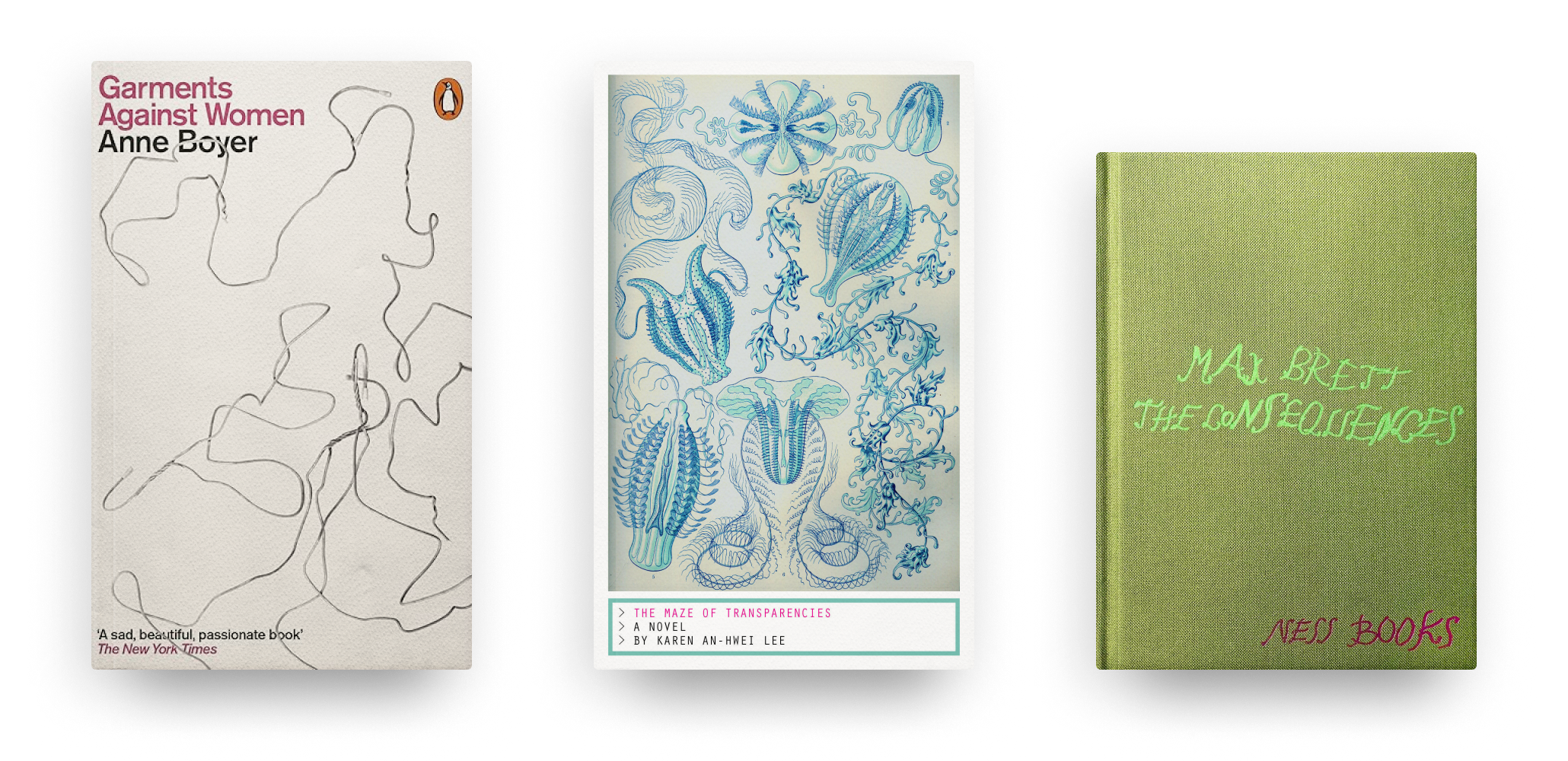
I began with Anne Boyer’s Garments Against Women (2015), which I picked up after reading an excerpt in Bookforum. Boyer’s book is concerned with the ordinary and even unliterary aspects of life: working, paying rent, getting sick, opening emails. There is a frankness to her writing—which makes her subtle leaps into evocative language feel so lovely, sudden, and fresh:
There is a risk inherent in sliding all over the place. As if the language of poets is the language of property owners. As if the language of poets is the language of professors. As if the language of poets is not the language of machines…
I think mostly about clothes, sex, food, and seasonal variations. I have done so much to be ordinary and made a record of this: first I was born, next I was a child, then I learned things and did things and loved and had those who loved me and often felt alone. My body was sometimes well, then sometimes unwell. I got nearer to death, as did you.
After Boyer, my flatmate lent me a copy of Karen An-Hwei Lee’s The Maze of Transparencies (2019), a novel with a particularly poetic thrust to it. (There are more obviously poem-shaped passages in it, too.) Ten pages in, I knew would be one of my favorite books of the year.
The Maze of Transparencies is set in a pastoral future, after the collapse of a cloud-computing surveillance state. Yang is a former data scientist (of a kind) who now tends to a very Berkeley Bowl–esque garden and calculates everything using his family’s jade abacus. It’s a charming post-computing fable, narrated by one of the clouds that Yang used to log into, Penny (short for Penelope the Predictive Panoply of People’s Data). In between stories of Yang’s encounters with various strangers, Penny broods over the technically advanced (but politically corrupt) past, and the strangely low-tech present:
Dispossessed, I was a homeless cloud. Without users to shepherd, without a server, without a flock to accommodate, I roved the data dumps of cryptoshredding, seeking jellyfish connectivity. Gone with the mazuma.
The fiscal bubble burst long ago. However, the sea of disinformation, once an unvarnished basin of falsehoods tainted by opioid-laced analysis, continues to reek of propaganda. No longer beloved by nonprofiteers and do-it-yourself gardeners, now one of a final posse of clouds surviving the apocalypse, I waft over a nonbinary gulf.
You’ll either love or hate this book. I loved it: the worldbuilding is lovely and strange and charming; and as a Californian, I tend to enjoy books that exuberantly pilfer nouns from the health-food aisle:
When life throws lemons at us, we analyze data about making lemonade. A cliché of a bygone age, no? Ounces of citric acid sealed in a waxy yellow rind? We overthink our figures of speech. Yet this lemonade principle is a foreign concept to this generation. No medicine exists for an epidemic of sour narcissism with neurasthenia riding upon its hairy back. No dosage of kava kava root, no mood-soothing tonics laced with norepinephrine, not even a tablespoon of hot almond milk with a drop of antimicrobial honey for ulcers, nor a shot of caffeinated chlorophyll can dispel melancholy for long.
I’ve never read anything like this book. It’s a little twee, at times—but what Lee does with language is so evocative and funny and unexpected! The book feels like an ideal synthesis of my more literary/verbal and STEM interests, too:
The last poetry book I read was Max Brett’s The Consequences (2024), which is described as “a hybrid collection of prose and poetry.” Brett’s book came into my life after a weekend in Paris, where I made the financially unwise decision to visit the art book fair Offprint. I told myself I was just browsing,—and of course I bought 6 books and a very heavy magazine, which I dragged onto the Eurostar from Paris back to London.
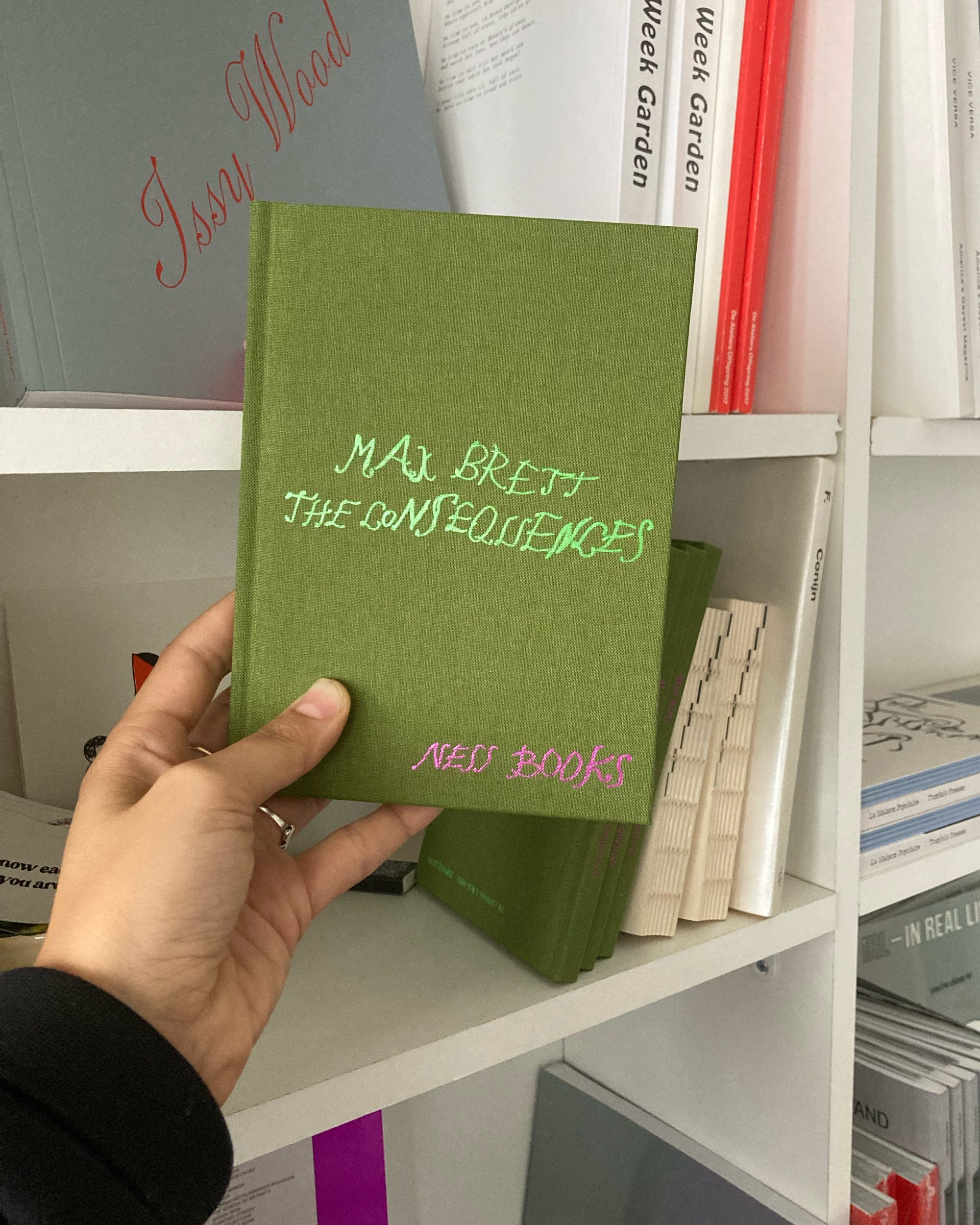
But it’s hard to regret buying Brett’s book, which is beautifully designed and printed by the French studio Espace Ness. Inside are 40…poems, or fragments, or short stories, with elliptical and varied titles like:
Fruit Baskets and Performance Evaluation
His
Hers
Hers (Continued)
Aspirational Daydreams Regarding the Reading List of Susan Howe
Qatar Airways Meal Optionality
Why Time Passes Quickly
The State of Things
The Worship of Georges Perec
The poems loosely chronicle the autofictional narrator’s breakup and subsequent move from New York to Paris. In Paris, the narrator goes to tabac bars, rides the métro, and riffs off of other, more famous poems:
[from Fruit Baskets and Performance Evaluation]
Thank you for the variety of plums on offer.
It wasn’t made clear during onboarding here in the nondescript suburbs of Paris near the île de la Grande Jatte that every Monday employees would have access to giant wicker baskets full of plums…
Reine-Claude plums.
They are so cold and sweet.
There is a crispness and a softness.
A crisp-soft interplay.
You have to be a bit playful to enjoy this book, I think. You can’t be shocked that the poem about Perec ends with the line:
[from The Worship of Georges Perec]
“The spicy noodle” is French slang for “anus.”
Three books about music and philosophy
I’ll close out this newsletter with 2 books about listening to music, and a tiny book about…Kant. (Who had something to say about music—and something to say, it seems, about every possible topic in existence.)
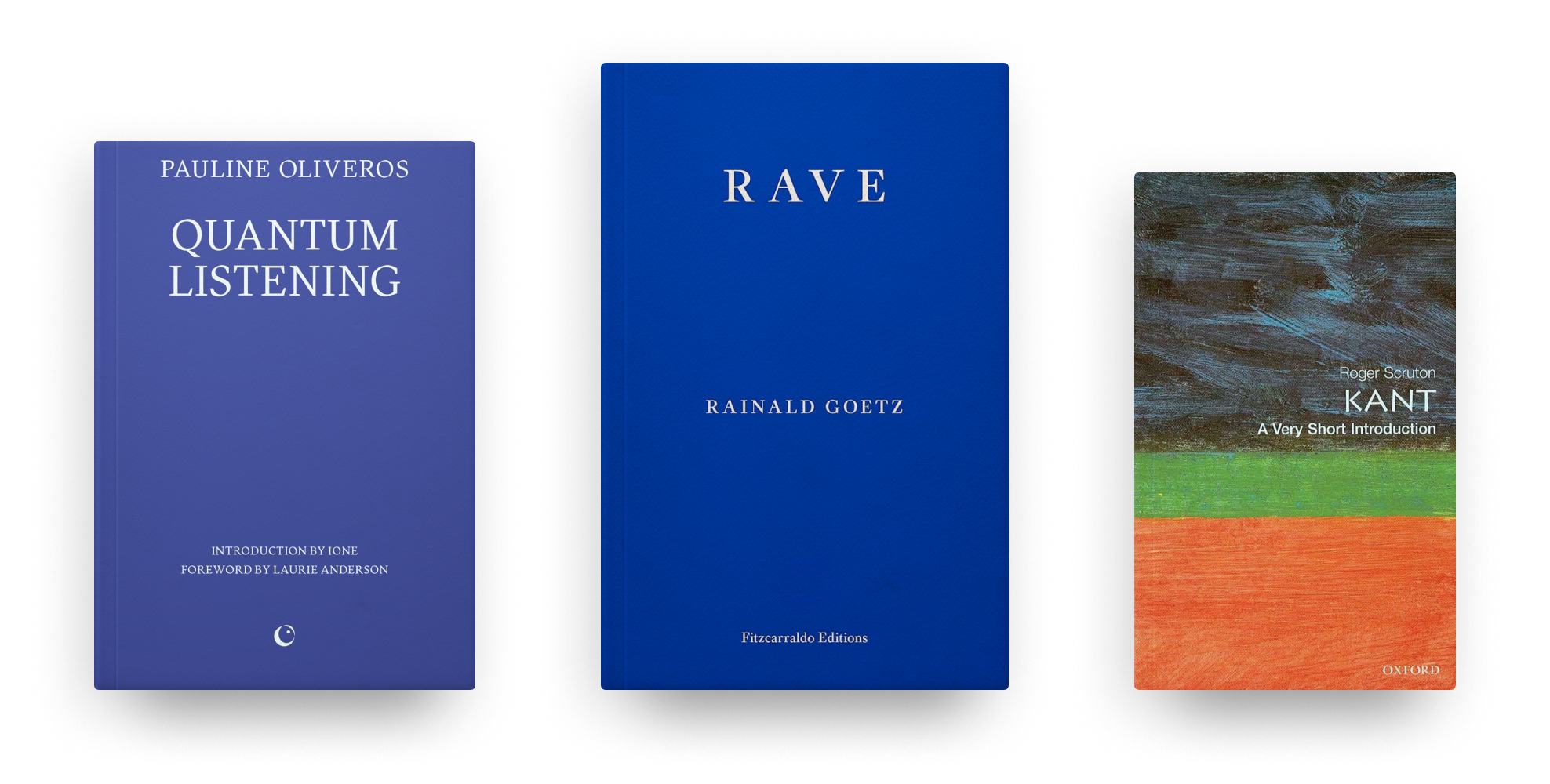
I’ve been interested in Pauline Oliveros ever since taking a writing class with Jenny Odell (the Bay-Area based artist and writer of How to Do Nothing), where Odell referenced Oliveros’s concept of Deep Listening.4 So when I saw the composer Pauline Oliveros’s Quantum Listening at the Serpentine’s bookshop earlier this year, I immediately bought it. It’s a slim, 70-page book, containing an introduction, a foreword, and then an essay by Oliveros. When I read it in late November, I felt a little…underwhelmed, maybe? I’d put off reading it for months and months, imagining that it would be a particularly revelatory and significant text. But the first half of Oliveros’s essay is a loose reflection on the practice of listening attentively, and how it has shaped her work as a musician and composer. It isn’t too different from a typical Buddhist exhortation towards mindfulness, though Oliveros’s does touch on the interplay between human behavior and technology:
Deep Listening is listening in every possible way, to everything it’s possible to hear, no matter what you are doing. Such intense listening includes the sounds of daily life, of nature, or one’s own thoughts, as well as musical sounds.
Deep listening represents a heightened state of awareness and connects to all that there is. As a composer I make my music through deep listening…
I see and hear life as a grand improvisation – I stay open to the world of possibilities…Our improvisations will soon include accelerated artificial evolution – hybrid humans – new beings born of technology – new challenges, consequences, dangers, freedoms and responsibilities – all of this in addition to the life we lead through the habits of our own traditions.
The second half leans into the concept of Quantum Listening—quantum, here, seems to be partially inspired by quantum physics, but not in a particularly structured way. I think I’d have enjoyed this essay more if I thought of it as an Are.na block–sized amount of information, and not a book.
But I thoroughly enjoyed the other music-related book I read in October and November: the German writer Rainald Goetz’s Rave, translated by Nate West. I’ve suffered many indignities in my attempts to read Rave over the years: I first ordered a copy in 2020, and the package was stolen; and I accidentally mailed my second copy, purchased in 2021, to an address I no longer lived in.
But this year, I managed to procure a copy from the library—and it was worth the wait. There’s a lot of recent writing about techno and raving out there:
The media scholar McKenzie Wark’s Raving (2023)
The anthology Writing on Raving (2025), edited by Wark, Geoffrey Mak, and Zoë Beery
The anonymously edited and authored Raveforum (founded in 2023)
Michelle Lhooq’s excellent and very funny newsletter, Rave New World
The music journalist Chris Zaldua’s Certain Sound (also the co-organizer of the Vague Terrain parties, also a friend!)
—as well as critical assessments of whether all this writing makes for good raving, like the journalist Chal Ravens’s essay for The Quietus on the academicization of the rave.
But Goetz’s Rave—initially published in 1998 and only translated from German in 2020—is one of the earliest and greatest works in the genre. There’s an art to writing about raving; the best works distill the phenomenological (and insistently embodied) feeling of the dancefloor (and, sometimes, the drugs that might accompany the experience) into prose. Not all of it can be distilled, of course—reading about a party is no replacement for being there yourself. But Rave gets close. Goetz got a history PhD and an MD before turning to writing, and the book—sharp, funny, cogent—moves nicely between the intellectual and the insistently sensorial. He beautifully depicts the heady, dizzy feeling of sociability–anonymity–sociability again while on a dance floor. And West’s translation has real velocity and flow to it—transmitting the ebb and flow of the narrator’s journey from party to party, city to city, nighttime to daylight.
It’s also just funny, for anyone who’s spent their nights obligingly nodding along, while DJs discourse intensively about what happened (or should have happened) on the decks:
And the last book I’ll cover in this (now excessively long) newsletter? I read my secondhand copy of Roger Scruton’s Kant: A Very Short Introduction. After referencing Kant’s categorical imperative in an earlier newsletter, I began to feel a little uneasy. I actually knew very little (okay, nothing) about Kant—but as someone attempting to write criticism, it seemed like I should have some passing familiarity with Kant’s contributions to aesthetic philosophy.

I’ve read 2 or 3 other books in Oxford’s Very Short Introductions series, and they’ve all been great: concise, useful, and not too dry. The series is especially helpful for a crash course on a specific philosopher—it’s a little more accessible than the Stanford Encyclopedia of Philosophy, in my opinion.
Scruton’s book on Kant begins with a useful explanation of 2 of Kant’s predecessors (Leibniz and Hume) and how Kant responded to their ideas. He then efficiently covers the categorical imperative in 23 pages; and Kant’s aesthetic philosophy in…16 pages. I did say it was a crash course! I’ll likely return to Scruton’s book again, to remind myself of the ideas—but I’m very glad to have it in my library.
The last 2 months of reading through my tsundoku have been surprisingly fruitful—philosophically, musically, poetically, and critically. And now that it’s December, I’m starting to think about two things.
First: The 2-year anniversary of personal canon is coming up, so I’ll be back in your inbox soon—with reflections on going from 0 to 28,000 subscribers, how to build sustainable writing habits, and more. (Send me any questions you have!)
Second: It’s almost time for my best books of 2025 newsletter, where I revisit the best fiction, nonfiction, and more. You can read my newsletters from 2024 and 2023 here:


Thank you, as always, for reading! And I’d love to hear about your favorite books—please do comment below, email me back, or share a link to your Substack posts!
I’ve met and corresponded with so many readers this year, and I’m really grateful for all the thoughtful, perceptive, and intelligent people I’ve met by writing on the internet. Wishing you all a lovely December and a peaceful end to the year.
The critic BDM recently inveighed against the use of “increasingly,” noting:
Many are the sins of blogging, but “increasingly” is the sort of terrible word that thrives in the professional environment. That is because “increasingly” is a way of faux historicizing. It gives whatever you’re saying an aura of knowledge, even of expertise, but does not really give the reader either of these things. You can, without falsehood, say that we were less entranced by the labubu in the past, something that is undoubtedly true because the labubu did not exist except perhaps in the pure Platonic realm of forms. Between “no entrancement” and “any entrancement” lies an increase.
Because I respect and admire McClay as a writer, I undertook an inventory of my own uses of “increasingly.” The results were horrifying.
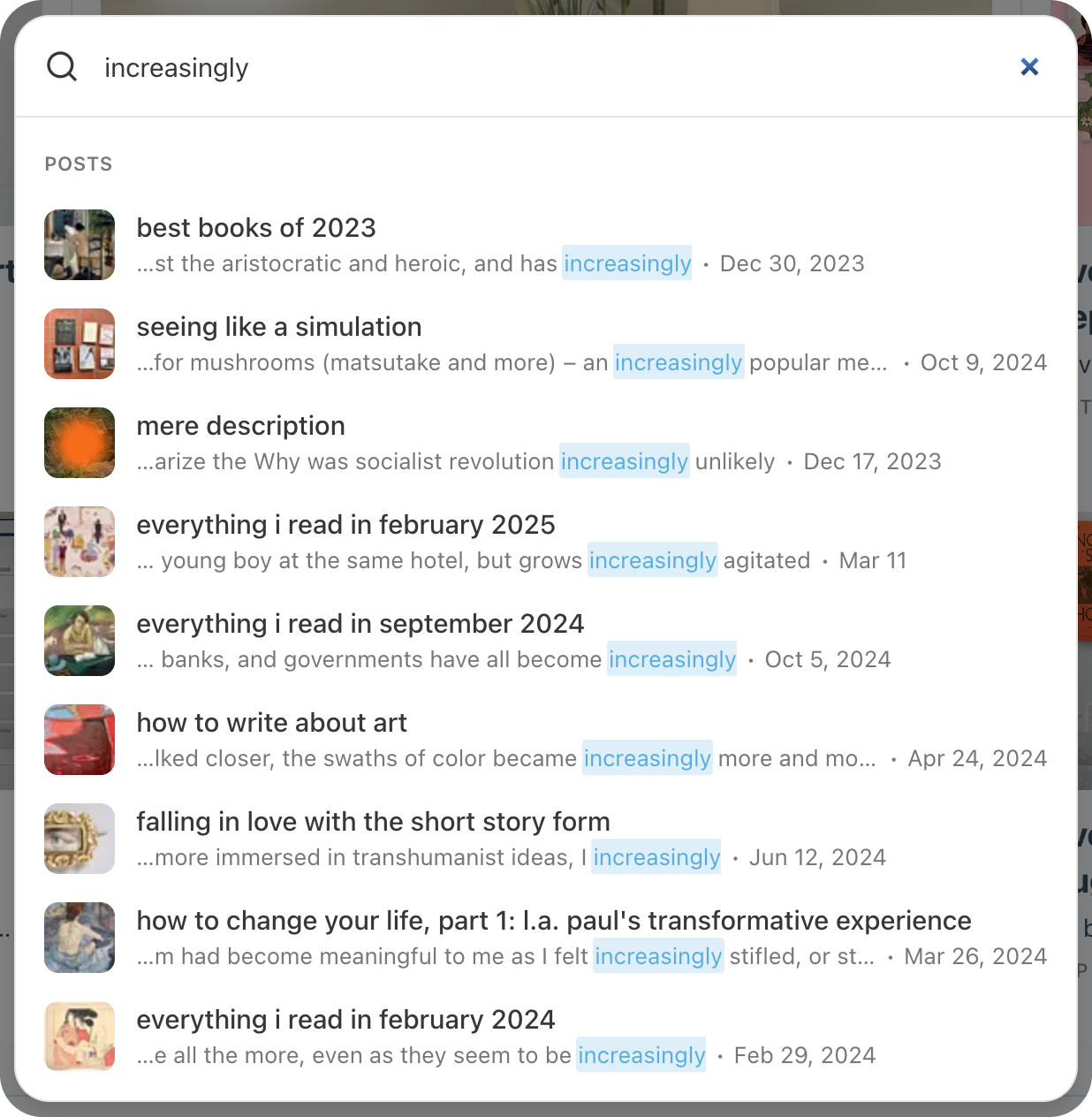
To be fair, some of these were direct quotes of other writers:
Lewis Gordon on matsutake as “an increasingly popular metaphor for resilience”;
Stuart Jeffries asking, “Why was socialist revolution increasingly unlikely in the 1920s?”;
Greg Jackson’s short story about a man feeling “increasingly stifled” in his life;
Meghan O’Gieblyn observing that, as she read more about “transhumanist ideas,” she “increasingly came to experience…déjà vu” about how similar these ideas were to ones she’d encountered as a theology student
Cristina Campo describing the 20th century as “the era of fugitive beauty, the era of grace and mystery on the verge of disappearance…all those things that certain men refuse to give up…even as they seem to be increasingly lost and forgotten”;
Helen DeWitt lamenting that we “live in a society where the humanities are increasingly dismissed as impractical.”
But the rest?
I summarized the argument of Erich Auerbach’s literary criticism book, Mimesis, as:
Western literature has developed an interest in the lives of ordinary people, not just the aristocratic and heroic, and has increasingly become committed to describing their reality in all of its socioeconomic and historical detail—including the class relations involved.
Verdict: An acceptable use of increasingly, since Auerbach does explicitly historicize his argument.
I also summarized Dan Davies’s nonfiction book, The Unaccountability Machine, as:
Liberal democratic governments + large corporations have essentially structured themselves so that…they are not capable of processing information about risks and negative outcomes…[and have] become increasingly incapable of handling the complexity of contemporary life and political/economic systems.
Verdict: Also acceptable, since Davies’s book seeks to historicize this (using a provocative argument that characterizes neoliberalism as, essentially, an opinionated information filter).
I described my experience seeing the artist Rachel Jones’s work at the Museum of the African Diaspora in San Francisco
As I walked closer, the swaths of color became increasingly more and more detailed.
Verdict: So basically I am saying that…you can see more detail as you walk closer to something? Incredible! This is why it’s useful to reread your old writing; you find mistakes that you never want to make again.
I described the plot of Death in Venice (Luchino Visconti’s film adaptation of the Thomas Mann novella) as:
[A] composer ends up falling in love with a young boy…but grows increasingly agitated by the strength of his passion and the anguish of feeling that his affection is immoral and futile.
Verdict: I keep on doing this thing where I list two things at once—strength of passion/anguish of feeling; immoral/futile—and I do it in a way that renders my clauses particularly tangled and unwieldy. I also need to stop doing this. The use of “increasingly” is fine; it’s everything else that is bad.
Interestingly, my use of increasingly has decreased over time: it appears 7 times in newsletters from 2024, but only once this year. (Aside from this footnote.) It appears that I am…increasingly…attentive to the dangers of “increasingly”…
Because I’ve never lived in NYC, I can’t really tell if Dimes Square was ever a politically or artistically significant place—versus a phrase that people began putting into headlines so people click on them. (I have to confess: I always click. But then I hate myself after.)
As the writer John Ganz wrote back in 2022,
If you spend far too much time online, you may at this point have become aware of a tangle of related signifiers like “Vibe Shift,” “Dimes Square”…Once again, after a long period of cultural stagnation, something is supposed to be happening downtown: a cultural shift, a new aesthetic orientation, a new avant-garde…
Above all, an avant-garde needs to be marked by journalists as inaugurating a new epoch—initiating a “vibe shift” if you will—even if it is mostly an empty distinction. The scene then also inevitably attracts the dorks and posers as well as orbiting critics and commentators, who participate through rejection and are symbiotic or parasitic, because they cannot help advertising their proximity even as they criticize.
I’m not that interested in Dimes Square as a phenomenon. (And according to Ross Barkan, that whole scene is over, anyway.) Which is why I feel that any affiliated writers (what does it even mean for someone to be Dimes Square-adjacent?) are probably more usefully discussed in relation to…their writing, which is what I’m trying to do for Zoe Dubno here, and with the playwright and novelist Matthew Gasda in my September newsletter.
I also liked this interview that Dubno did with The Creative Independent, where she declares:
I know now that the way that you write a novel is by consistency, not by any kind of genius. You can choose your number, but for me, it’s 1000 words a day…That’s a very achievable goal. That’s actually two, maybe three hours of hard work. If you’re really working on the novel, you can’t skip. If you miss a day because you were sick, fine. But besides that, no. Weekends off, but it’s your job.
—which reminds me of an essay by the poet and novelist Ishmael Reed, where he writes: “American talent is not rare. It’s common.” I don’t really believe in genius, and I sometimes wonder if the difference between a bad/unpublished novel, and a good/published one, lies in:
The perseverance and discipline of the writer;
And the support and receptivity of external institutions (agents, publishers, &c) that might help the writer bring their work to a broader audience
If you’re a Bay Area–based writer of color, look into the Kearny Street Workshop’s Interdisciplinary Writers Lab—you work with 3 teachers in poetry, fiction and nonfiction. I attended in 2024, when the teachers were Jenny Odell, K-Ming Chang, and mimi tempestt.
Great insights! What was the story about a pastoral future after the collapse of cloud computing? Thanks so much :)
I found my way to Mating through Becca Rothfeld's essay on the book in her All Things are Too Small collection, where she really focuses on the love/conversation idea. Really enjoyed mating, and I suspect in part because I was primed to think about the relationship in those terms!