
everything i read in february & march 2026
and! my Dialectic podcast episode on creative fulfillment and the life of the mind ✦

In the last few years, I’ve written thousands and thousands of words about the same idea: that reading more (books, magazines, and essays) will change your life for the better. It will satisfy you more than the slop that is, supposedly, more entertaining and fun to consume. It will draw you closer to other people, closer to the world. It will disturb your pre-established understanding of the world and offer a subtler, richer, deeper experience of reality.
Each of my newsletters can be read as a love letter to literature, and to the people (writers, editors, translators, publishers, booksellers, critics) that bring great books into our loves. But before I get into this month’s newsletter—featuring 9 books about Chinese philosophy, psychoanalysis, Proust, and more—I’m excited to share something slightly different:
I spoke to Jackson Dahl, the host of the brilliantly discursive and wide-ranging podcast Dialectic, about nurturing one’s mind through books, conversations with friends, and writing in public. You can listen on Spotify (above) or on Substack (below). Committed wordcels can find the episode transcript here.

Jackson and I talk about my deep love for the San Francisco public library…why the best technologists are students of history…articulating a positive vision of the future…good and bad note-taking systems…and why intellectual work is best done with other people. I’m a huge fan of Dialectic—Jackson is a phenomenal interviewer, and brings on brilliant guests across technology, culture, media, and art—so it was very exciting to speak with him.
And now back to our (ir)regularly scheduled content! For newer personal canon readers: I send out monthly-ish newsletters reviewing a wide range of novels, nonfiction, poetry, and essay collections.
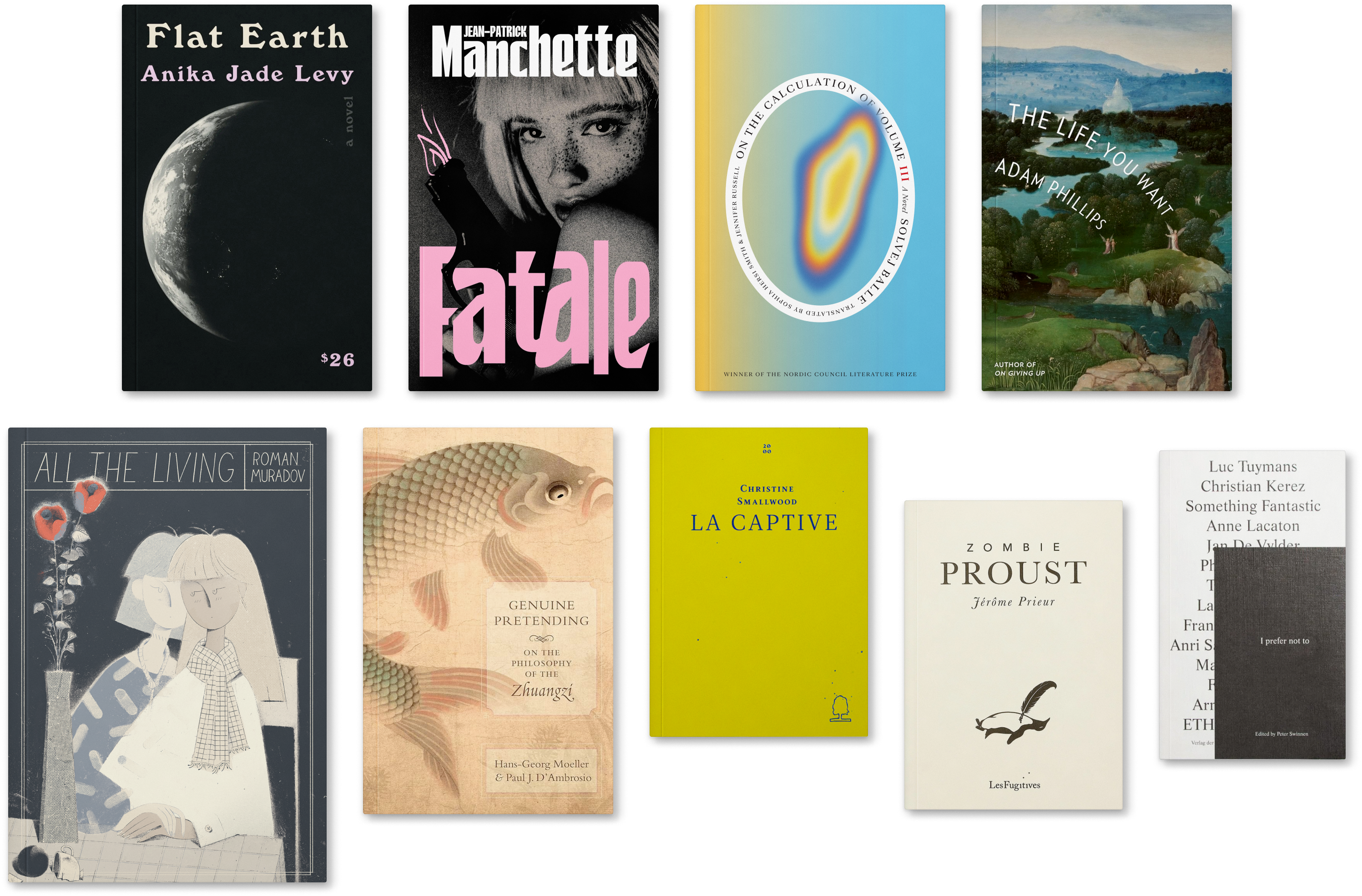
This newsletter includes 9 books I read from February–March:
2 novels that take a fatalistic perspective on sex, status, money, and romance
A Danish novel about reliving the same day over and over
The latest Adam Phillips book on psychoanalysis and pragmatist philosophy
A touching, meditative graphic novel by the artist and writer Roman Muradov
2 short books on Proust (and Chantal Akerman’s adaptation of Proust)
And a very tiny book on ‘professional abstinence and obstinacy’ in architecture
Reviews below, along with bonus reflections on a 20th century typeface popular with nostalgic 2020s designers; US versus UK cover designs; the surprising similarities between fan fiction and literary criticism; and why plotless films are (sometimes) the most memorable ones.
The novel as nihilistic project
It’s not easy being a young woman in the 2020s. It’s not easy because the internet, at its worst, seems designed to make you insecure, anorexic, paranoid, depressed, and dumb. And it’s not easy because a novel about all these feelings will be thoroughly dissected—sometimes fairly, sometimes unfairly—for its literary and political shortcomings.
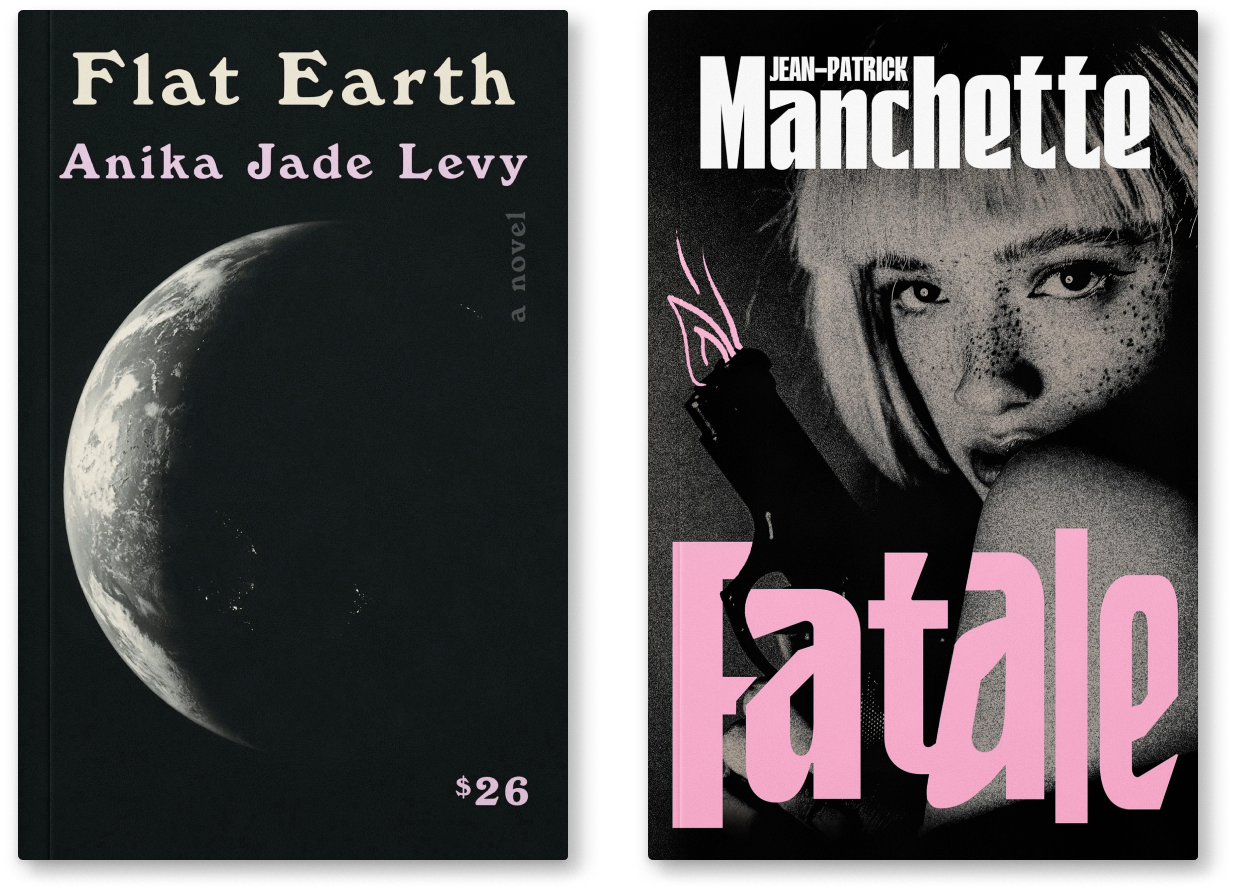
I picked up a copy of Anika Jade Levy’s Flat Earth after reading a number of highly polarized reviews:
Gabrielle Schwartz, writing in The Guardian, found it ‘slim and sharp,’ and ‘bleakly relevant to all of us.’
Ann Manov, the founding editor of The End, panned it in The Baffler as ‘a world of flat, dull characters who do nothing, say nothing, and feel nothing for each other but a mild and mutual disdain.’
Kieran Press-Reynolds, writing for Bookforum, had a particularly insightful, balanced take on the novel’s strengths and weaknesses:
Flat Earth is, by its own terms, ambitious, trying to catalogue and capture the myriad ways we’re being rewired by and responding to the shit-post-modernity we’re living through. Levy deftly conveys how the desperate craving for subcultural coolness has corroded us…
The problem is that satirizing a time that already feels like satire doesn’t feel particularly novel…Levy is locked in on the micro-typologies of personality and the macro-structure of the moment, but she doesn’t really take us anywhere new or offer a definitive stance on or disruption of this vortex of dread.
The newsletters I follow on Substack were equally split:
I’ve written before about my deep admiration for Dhimmi Monde, which focuses on small and independent presses. Michael M———’s review essay offered a measured amount of praise, while situating the novel’s fragmentary style in the broader literary landscape:
Let it not be said that literary fiction is not a genre, or at least that it does not contain its own sub-genres. Reading Flat Earth is not unlike reading a detective novel or watching a horror film — not only is almost everything on the page (or the screen) familiar, but so are its rules, its syntax. The pleasure, to the extent that such a work is successful, comes not from defamiliarization or invention but effective arrangement, artful tweaks to the formula…
The novel is a pretty breezy read…If you enjoy Ottessa Moshfegh and Mary Gaitskill, you will probably find the “debased e girl” descriptions interesting. That you could be reading someone who has already cleared the particular paths Levy treads is not a devaluation of her writing, even if the novel seems less certain of that.
And Grace Byron (I’m currently reading her debut novel, Herculine—an incisive/funny/unsettling horror story about getting back in touch with your ex-girlfriend) wrote a particularly savage critique of Flat Earth, alongside other ‘Dimes Square–adjacent books’ that portray a ‘depressing heteropessimism’ and a ‘hollow value system’ at the center.
The novel does seem flat, nihilistic, and morally vacant—intentionally so, and often enjoyably so. Early on, the novel declares that ‘The spirit of the age is paranoia and distrust about everything.’ These are the feelings saturating every social milieu, every interpersonal interaction of Flat Earth, which follows a young graduate student named Avery as she stumbles through status-obsessed scenes, hyper-aware of her unhappiness:
It was an art-world party with all the typical art-world party sensations: paranoia, diarrhea, the suspicion that one is making enemies faster than one is making friends…I felt stupid for showing up to something like this alone and unarmored, but I reminded myself that I was hungry and I wanted to party and a semipopular artist from the internet had invited me…
The best parts of Flat Earth are deliciously quotable and beautifully written. I loved the first half of the novel, which sets up a frenemy relationship between Avery and her wealthy, glamorous friend Frances—and began to feel disappointed halfway through, when it became clear that Avery was constitutionally incapable of making good decisions.
She wants to write, but can’t; wants to meet a nice man, but is tormented by cruelly inconsiderate lovers. She self-sabotages constantly and doesn’t believe in herself: ‘I always thought,’ she observes halfway through the novel, ‘that self-possession was a destination I’d arrive at in early adulthood…but I didn’t quit smoking pot in my early twenties or take any interest in my spiritual development, so it just never happened for me.’1
The lack of personal development depressed me, I have to say. And not really on political grounds—I suppose I’m always desperate to see a protagonist claw their way out of a bad situation into a better one, and I felt a little exhausted waiting for Avery to try. But it’s hard to say whether this is a problem with the novel (because of course novels are permitted to be nihilistic!) or a dispositional preference I have.
I did find myself very interested in comparing the US and UK covers for the novel, which take subtly different approaches. The US one explicitly references the popular countercultural magazine Whole Earth Catalog, which makes a brief appearance in the novel: a rising art-world star uses it to cut lines of coke for his houseguests.2 But Brand’s magazine—which has recently been digitized and can be read on The (Searchable) Whole Earth, a website by my friend Lucas Gelfond—isn’t nihilistic at all! For many technologists, it’s indelibly associated with a cheerful, pragmatic optimism.
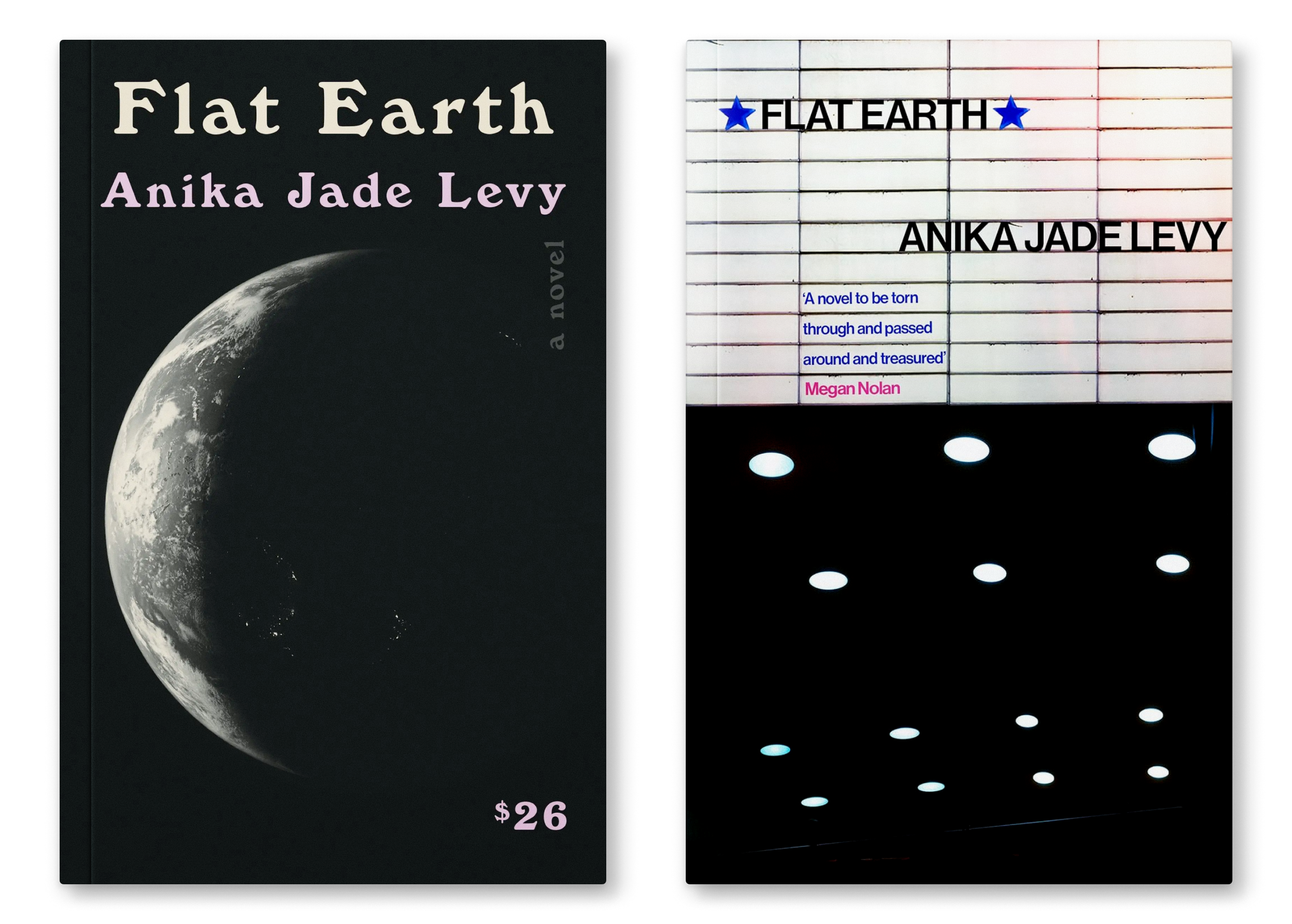
The UK cover employs a different visual motif: the marquee and lightbulbs at the entrances of movie theaters. Since Flat Earth’s protagonist is unhappily preoccupied by the success of her frenemy’s documentary, the cover makes literal sense but also aesthetic sense—it conveys the superficial showmanship and vapid emptiness of Avery’s world.
After finishing Flat Earth, I found myself more drawn to the UK cover’s interpretation—it perfectly expresses the hollowness and anomie of the novel. For those who have read Flat Earth (and those who haven’t!) I’d love to know how you feel about the two covers!
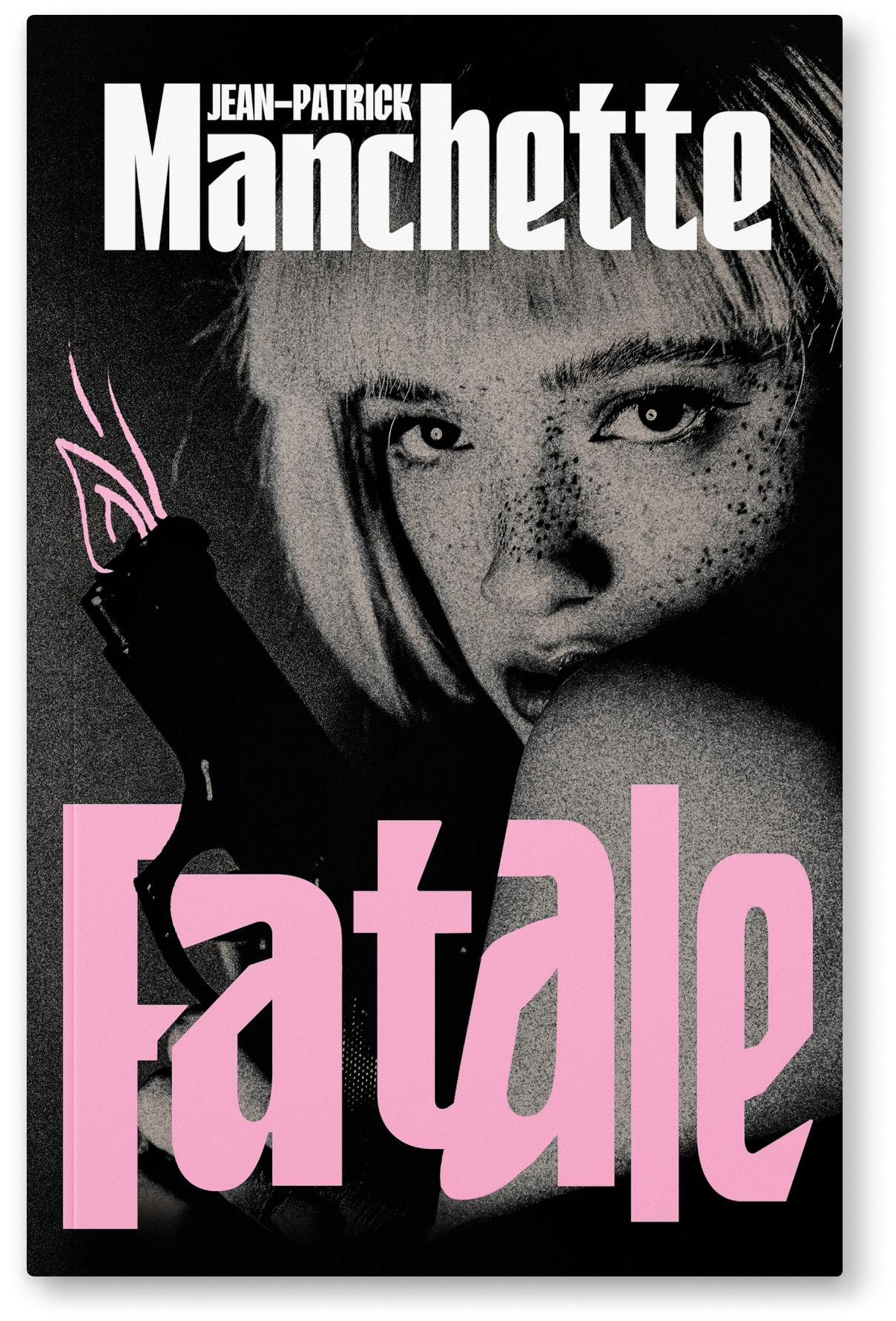
It was a bit of a shock going from Flat Earth to the French noir writer Jean-Patrick Manchette’s Fatale, an invigoratingly fast-paced novella (just 112 pages) originally published in 1977 and translated into English by Donald Nicholson-Smith. (There’s an excellent Bookforum interview with the translator, which also describes the enormous influence Manchette has had on French crime fiction.) It was shocking because Flat Earth’s protagonist has a total absence of agency, and the plot developments are largely about her suffering in her heterosexual relationships…but but the heroine of Fatale, the ruthlessly glamorous Aimée Joubert, has an exhilarating excess of agency.
As a result, a lot of plot happens in very little space. Aimée kills a man in the first 5 pages, before decamping to a small French town to manipulate, befriend, and seduce its residents—many of whom, it must be said, are equally agentic:
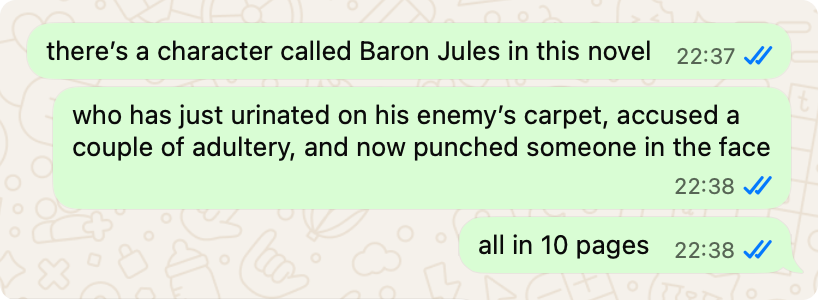
It’s easy to recommend this book. It’s a quick read, intensely plot-driven, and a strangely encouraging read.
I won’t spoil the twist at the end, except to say that it sabotages the heteropessimism that dominates the novella’s earliest scenes. Men and women lie, cheat, deceive, and abuse each other—but they do, sometimes, love each other. Which is nice. Life is short, and you might get assassinated halfway through. You might as well spend your time with people you like!
What makes for a life worth living?
Life is short—it’s true, and it’s also true that it’s long enough to produce an excess of suffering, rumination, uncertainty, and loneliness. What are we supposed to do with all of our time? What will make our lives worth living? And for readers grappling with these questions…are novels or nonfiction books better for finding the answers?
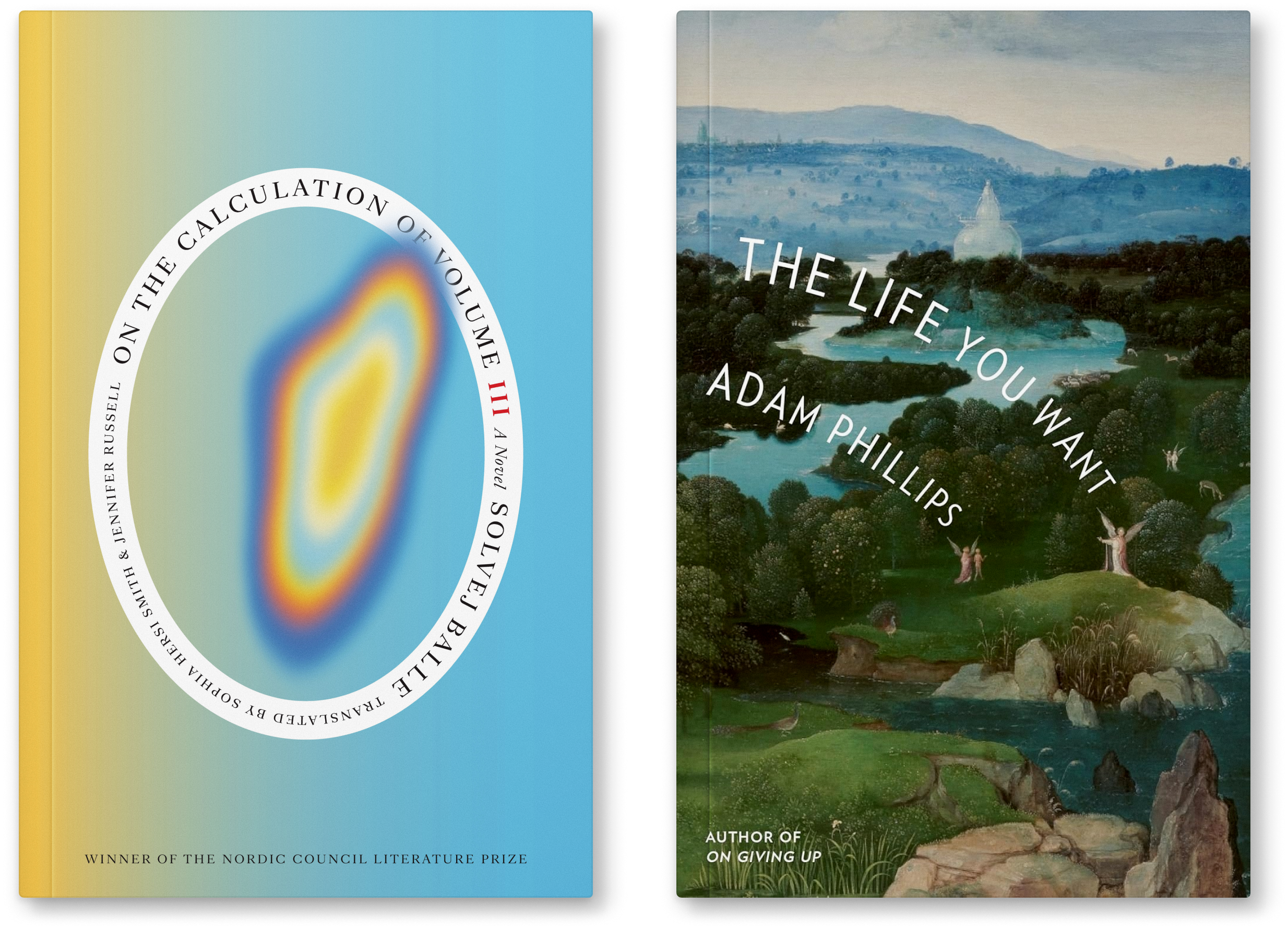
Both, I think, in different ways. The Danish writer Solvej Balle’s On the Calculation of Volume tackles this question through a speculative-fiction lens. The protagonist, Tara Salter, wakes up on November 18 to realize that she is reliving the same day—over and over and over and over. Balle’s septology (what is it with Scandinavian writers and their septologies?) took 30 years to write and was originally self-published. Volumes I through III have been translated into English by Sophia Hersi Smith and Jennifer Russell; volume IV is coming out in April.
On the Calculation of Volume is another polarizing novel. I blazed through vols. I and II within a day, and found them unbelievably, improbably absorbing (a difficult thing to pull off in a novel about repetition).
I wrote about vols. I and II in—

And I wrote about Balle’s US publisher, New Directions, in—

The third volume (thank you to my colleague, Daniel Rivas Perez, for lending me a copy!) is just as good. But when I had dinner with my friend Sophie last summer, at the iconic British restaurant St. John’s, she said that On the Calculation of Volume incredibly, incredibly boring.3
I’m hesitant to synopsize the plot of vol. III too much—but it is centrally concerned with 4 different philosophies for how to live, and how to spend your time—especially when that time could easily feel monotonous, useless, and pointless. The philosophies are showcased through different characters and their actions at different points of the story, and I found myself wondering: which one do I agree with most? Is life about the pursuit of knowledge and research as leisure activity? Is life about intimate relationships and familial ties? Is life about technological innovation and scientific discovery? Is life about political idealism and enacting radical changes in society?
Is life about recognizing that these aren’t mutually exclusive pursuits, and the same day can be carved up in different ways? I’m drawn to all of these goals, I think—and so I spend my days reading, speaking to loved ones, working at a tech startup, and trying to find my own way to contribute to a better future.
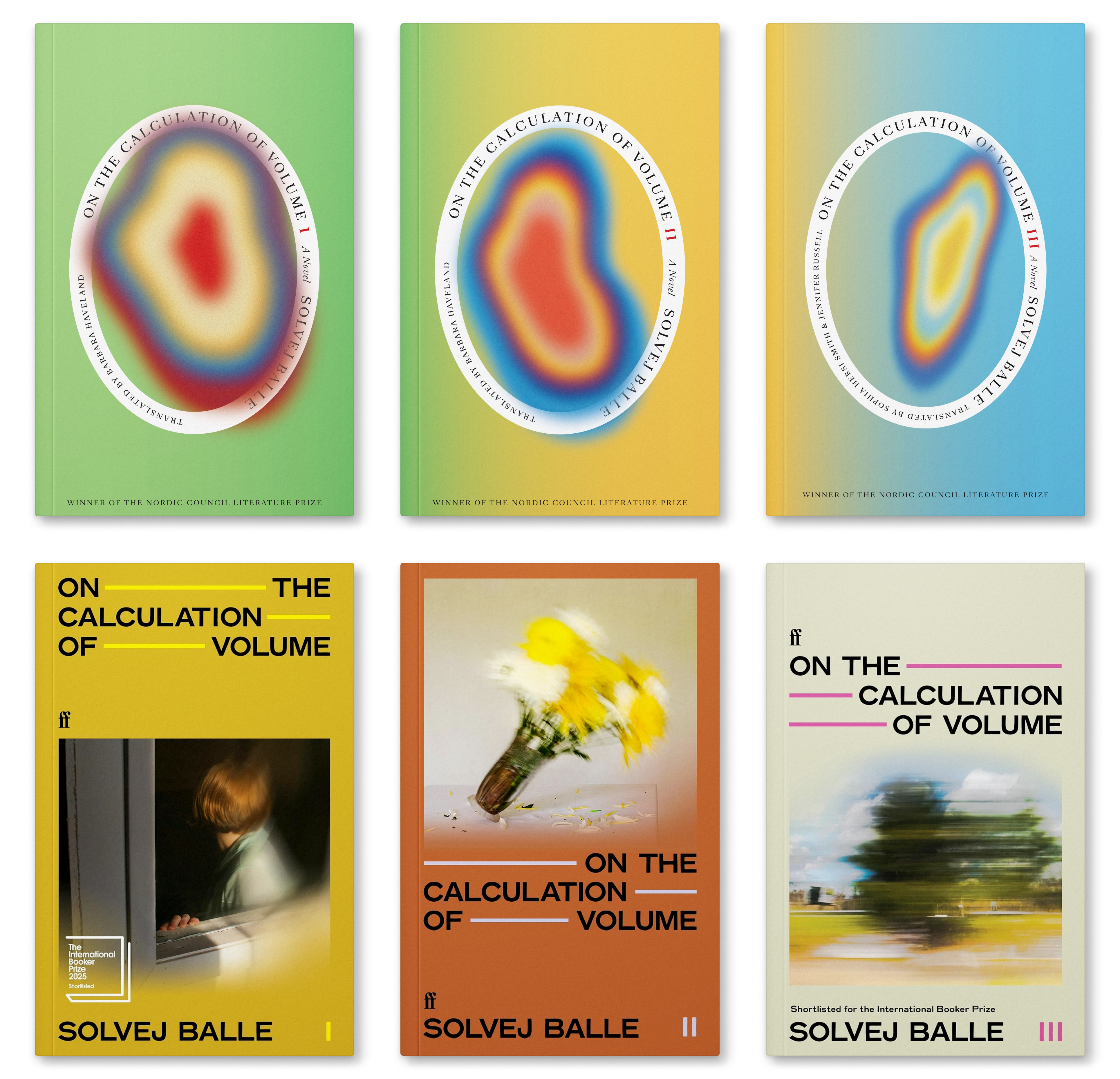
And just for fun…let’s play the US/UK cover game again. The US covers for On the Calculation of Volume are much more abstractly evocative—a smooth gradient that continues from volume to volume, with a crisp white band and a strange, auratic form inside it. It’s a beautiful way to evoke the time loop of the novel.
The UK covers are more pictorial—showing a woman, a vase, and a landscape, with a motion blur applied to convey the stagnant-and-rushing flow of time. The lines between the words of the title create a nice feeling of direction, and create both consistency and variety across each cover. I’m partial to the US cover (as a software designer, it’s hard to resist a gradient!) but both are striking approaches to a 7-volume series. I’m excited to see what volumes IV–VII look like.
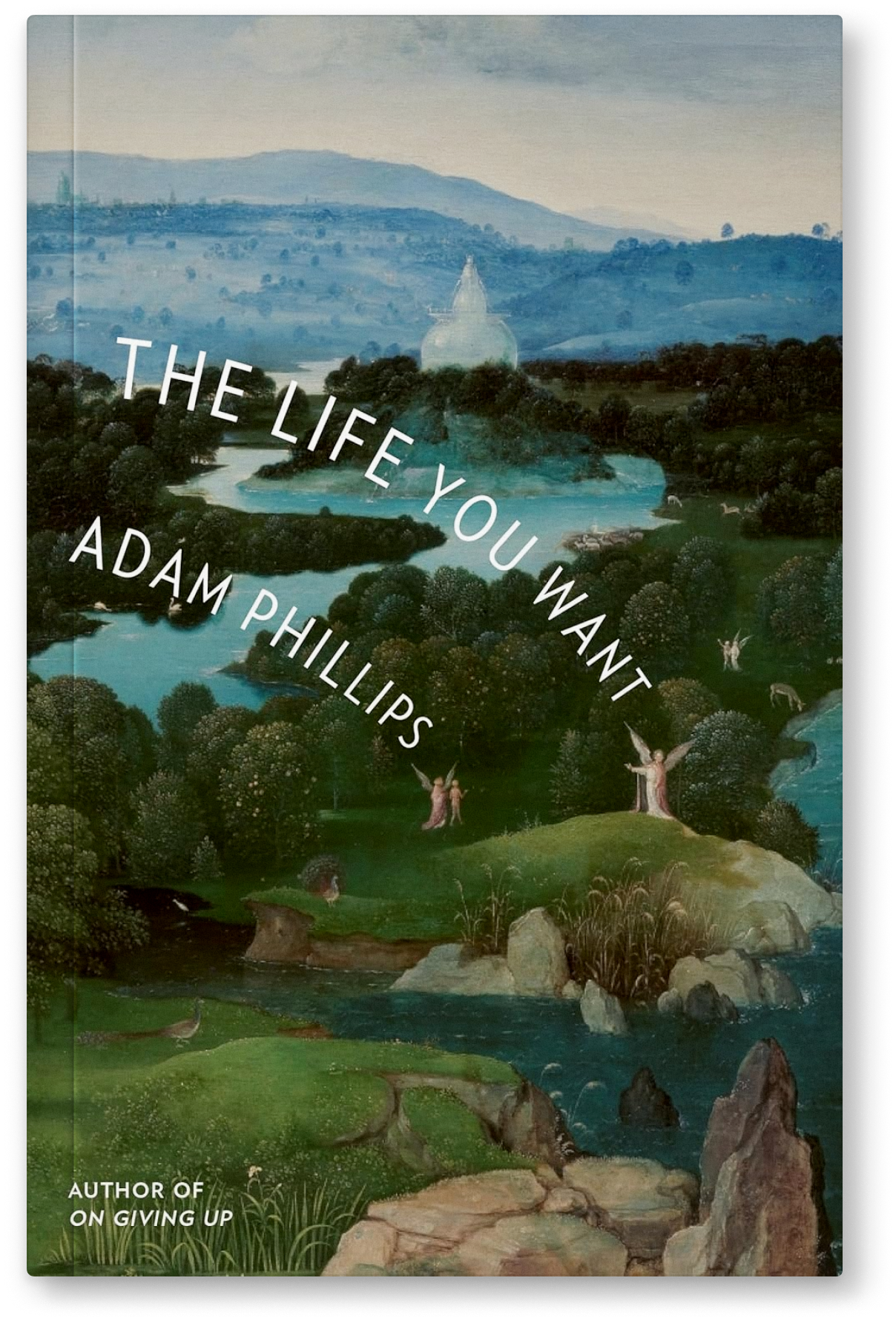
For explicit life advice, though, nothing beats a nonfiction book. But the British psychoanalyst Adam Phillips’s The Life You Want resists obvious conclusions and accessible platitudes. The book takes, as its starting point, Phillips’s 2024 essay for the LRB, which attempts to synthesize Freud’s psychoanalytic theories with Richard Rorty’s pragmatist philosophy. The two are ‘uneasy bedfellows,’ Phillips notes: Freud’s great discovery was the unconscious, and its subterranean and self-sabotaging tendencies; Rorty’s philosophy relied on conscious self-awareness and unconflicted, goal-directed agency.
I can’t help but wonder if the differences between these 2 thinkers—and how they sought to help people live better lives—may come down, at least partially, to biography. Freud was an Austrian Jew who had to flee Vienna in 1938, after Nazi Germany annexed Austria; Rorty was an American philosopher during the American century. The purpose of psychotherapy, for Freud, was to go from ‘misery to ordinary unhappiness’; the purpose of philosophy, for Rorty, seemed to involve ‘human solidarity…as a goal to be achieved.’ And novels and films, he suggested, had the potential to be ‘vehicles of moral change and progress.’
I wrote about Richard Rorty’s pragmatist philosophy in—

If Freud and Rorty are so different, how does Phillips manage to yoke them together in The Life You Want? By suggesting that these 2 different approaches produce a positive tension—Freud’s limitations are Rorty’s strengths; Rorty’s blindspots are Freud’s greatest achievements.
If you are not religious, Freud and Rorty both implicitly ask…what keeps you going; what makes you think your life is worth the frustration and disappointment and dismay and injustice that modern lives seem to entail?
…Psychoanalysis without pragmatism, one can say, becomes another pre-emptive coercive moralism…By privileging the past over the future…[and] unconscious causality over choice, it radically circumscribes human possibility. But Rorty’s pragmatism without psychoanalysis can sound wilfully naive about the difficulties, the conflicts of wanting…it tends to idealize both autonomy and the self; to privilege our capacity for making choices…It privileges experiments in living over the need for safety.
Psychoanalysis with pragmatism, and pragmatism with psychoanalysis, however – both deemed to be inextricable from each other – seem unusually promising. If, that is, they help you get the life you want.
Phillips is a terrifyingly prolific writer—he’s published 26 books since 1988—and the quality of each book varies. Out of the 4 books I’ve read (The Life You Want; On Giving Up; On Wanting to Change; and Unforbidden Pleasures), I do think that The Life You Want is the best: it showcases the best of Phillips’s inquisitive, gently penetrating style, and feels especially relevant for the existential questions of our time.
Why not say no?
Instead of trying to live a better life, of course, you could just—give up. That’s the subject of Adam Phillips’s previous book, On Giving Up, and it’s also the subject of the renowned artist and illustrator Roman Muradov’s All the Living. The US and UK have been slow to recognize graphic novels as capital-L Literature (unlike France), but Muradov’s book showcases the full visual and literary potential of the genre.
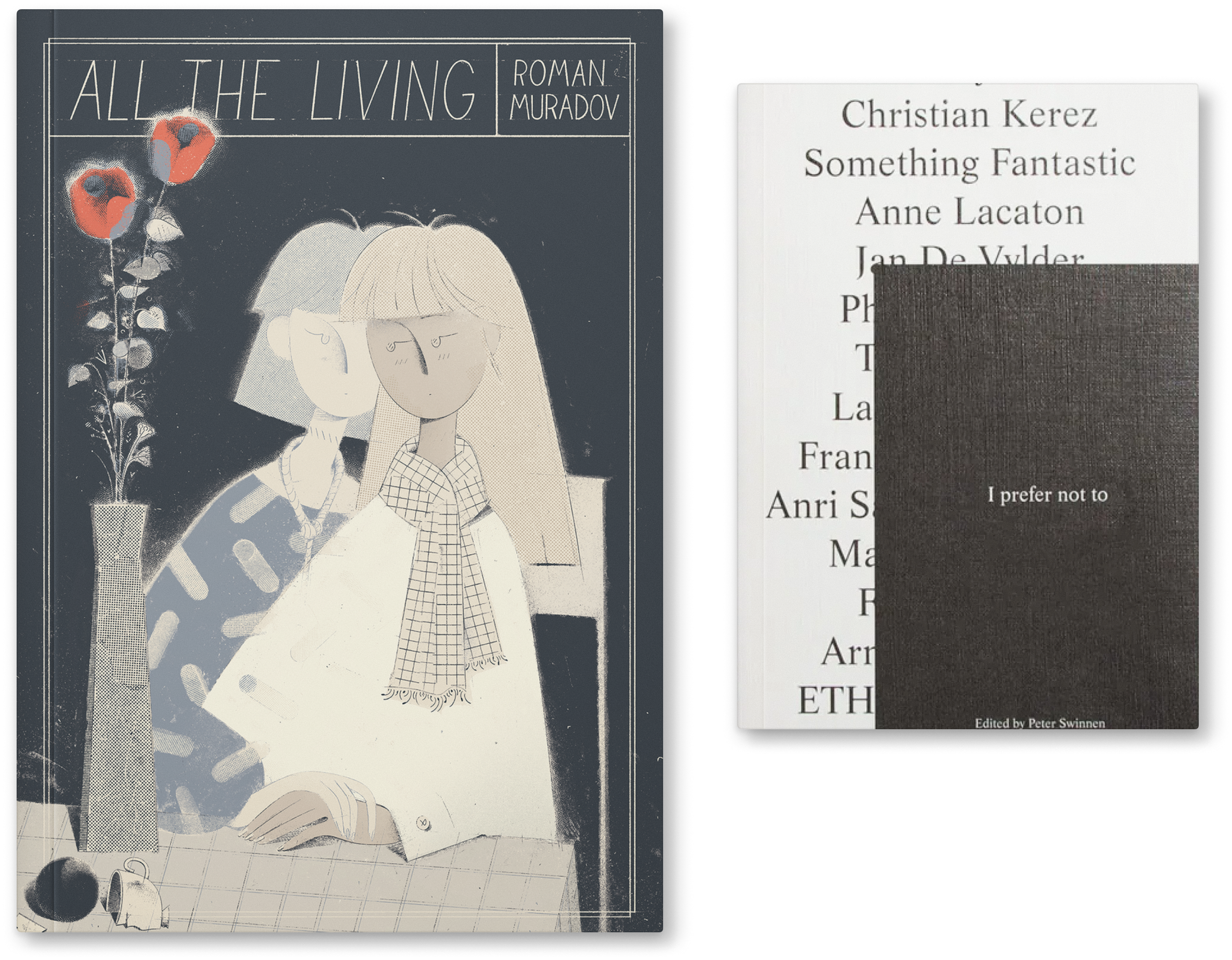
You might already know of Muradov’s illustrations—he’s worked with the New Yorker, the software company Notion, and the Paris Review (Lydia Davis fans, you must read this)—but he’s also a subtly comic writer, and ideally suited to handling heavy topics with a light touch.
In All the Living, a woman commits suicide—only to end up in a strangely sociable purgatory, where she’s forced to enter a lottery to return to life. Tragically (or farcically?) she’s the first person to win it. She’s unwillingly rushed back into the land of the living. It turns out to be just as monotonous as the first time around—but now she’s able to see all the ghosts of the dead thronging around her, gathering in offices and grocery stores and apartment buildings. It’s a touching story, full of tenderly awkward interactions between the protagonist and her local ghosts. All the Living is already sold out on Fantagraphics (you should have preordered it when I posted about the book last October!) but you can still find some copies here and here.
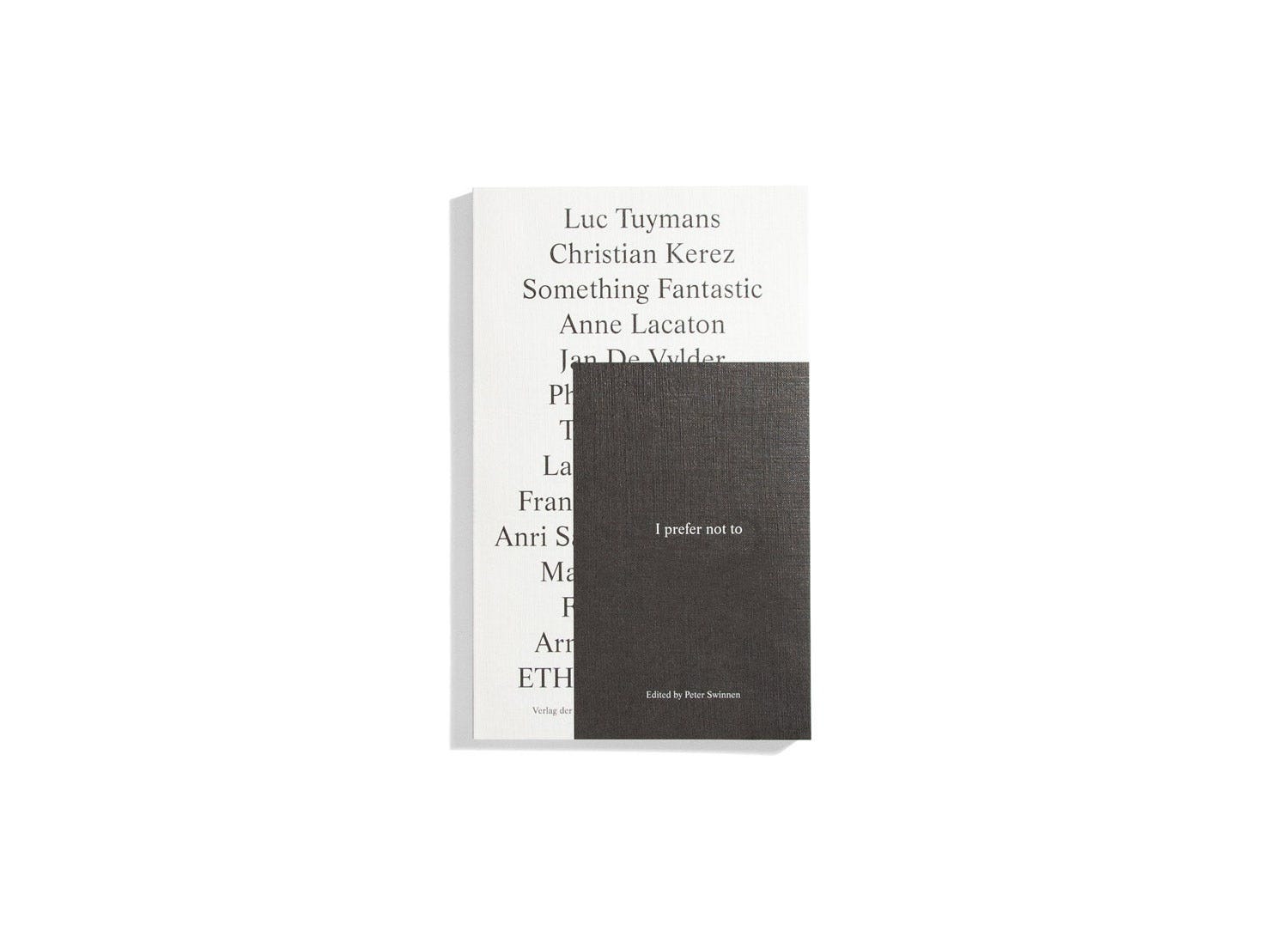
Design and architecture fans can find an entirely different perspective on refusal—in nonfiction (specifically lecture) form—in I Prefer Not To, edited by Peter Swinnen. It’s a tiny, irreverently designed book about a lecture series at ETH Zürich’s renowned architecture department. (The lectures were recorded and later uploaded to YouTube.) Twelve architects were asked to give a lecture inspired by the phrase, ‘I prefer not to’—which comes from Herman Melville’s famous short story ‘Bartleby, the Scrivener.’
A confession: the reason I bought this book is because it was beautifully designed (by Something Fantastic and Fernanda Tellez Velasco. A second confession: I bought it in December 2024 and didn’t open it until a few weeks ago, when I was speaking to a friend about the architect Anne Lacaton. A few years ago, I wrote a brief piece about Lacaton’s environmentally and socially conscious practice for Harvard’s architecture and design department:
As French social housing agencies seek to renew buildings constructed in the 1960s and 1970s, there is often a tendency to demolish and reconstruct. But Lacaton & Vassal’s philosophy is different: “Never demolish…Always add, transform, and utilize, with and for the inhabitants.” The original plan for a project in Bordeaux was to demolish three buildings of 530 dwellings built in the early 1960s. In lieu of this “violent” disruption and displacement for inhabitants, Lacaton & Vassal expanded the existing apartments by 53 percent and added eight new ones. During the two-year construction process, all residents remained in their homes. The result, compared to demolishing and rebuilding: one-third of the construction costs and half of the carbon footprint. No material was wasted, and the transformation led to a 60 percent reduction in energy consumption. “Transformation means: spend less to do more,” Lacaton said.
Lacaton’s I Prefer Not To lecture is profoundly invigorating. The book includes a simple list of Lacaton’s rules for herself: NOT TO ACCEPT THE MINIMUM, NOT TO LIMIT USES, NOT TO LOSE. (All useful lessons for architecture, design, and life!) Many of the speakers offered their own principles: the architectural historian Philip Ursprung began his lecture by saying:
Architecture – the ‘YES’ profession par excellence – can deeply and critically learn from the culture of ‘NO’.
The lesson from the lecture series might be that saying no to certain things—declining, or actively resisting other people’s demands—is an essential part of a creative practice.
Fan fiction, criticism, and the Proust extended universe
What are the other necessary elements of a creative practice? Being playful helps; being critical helps. There’s a certain playfulness to this Texte Zur Kunst essay, by the artist and writer Francis Whorrall-Campbell, which begins:
What genre of writing is produced in response to a cultural object? Is written from a place of love and admiration, sometimes indignation and disappointment, toward that object?…If you answered fan fiction, you’d be correct. If you answered criticism, you might also be correct.
I have, in previous newsletters, irreverently referred to certain essays, poems, and books as ‘Proust fanfiction,’ or ‘Proust extended universe content.’ I’m tickled by these descriptions because they help make serious, seemingly self-important Real Literature™ seem accessible and exciting. But it also reflects how writers and filmmakers have responded to one of the greatest works of modernist literature—by riffing off of the plots, characters, and ideas.
One of those filmmakers is the Belgian auteur Chantal Akerman. She’s best known for her film Jeanne Dielman, 23 Commerce Quay, 1080 Brussels, which I wrote about in June 2024:

But the Proust-pilled among us might be most interested in Akerman’s La Captive, which I later saw, and wrote about, in February 2025:

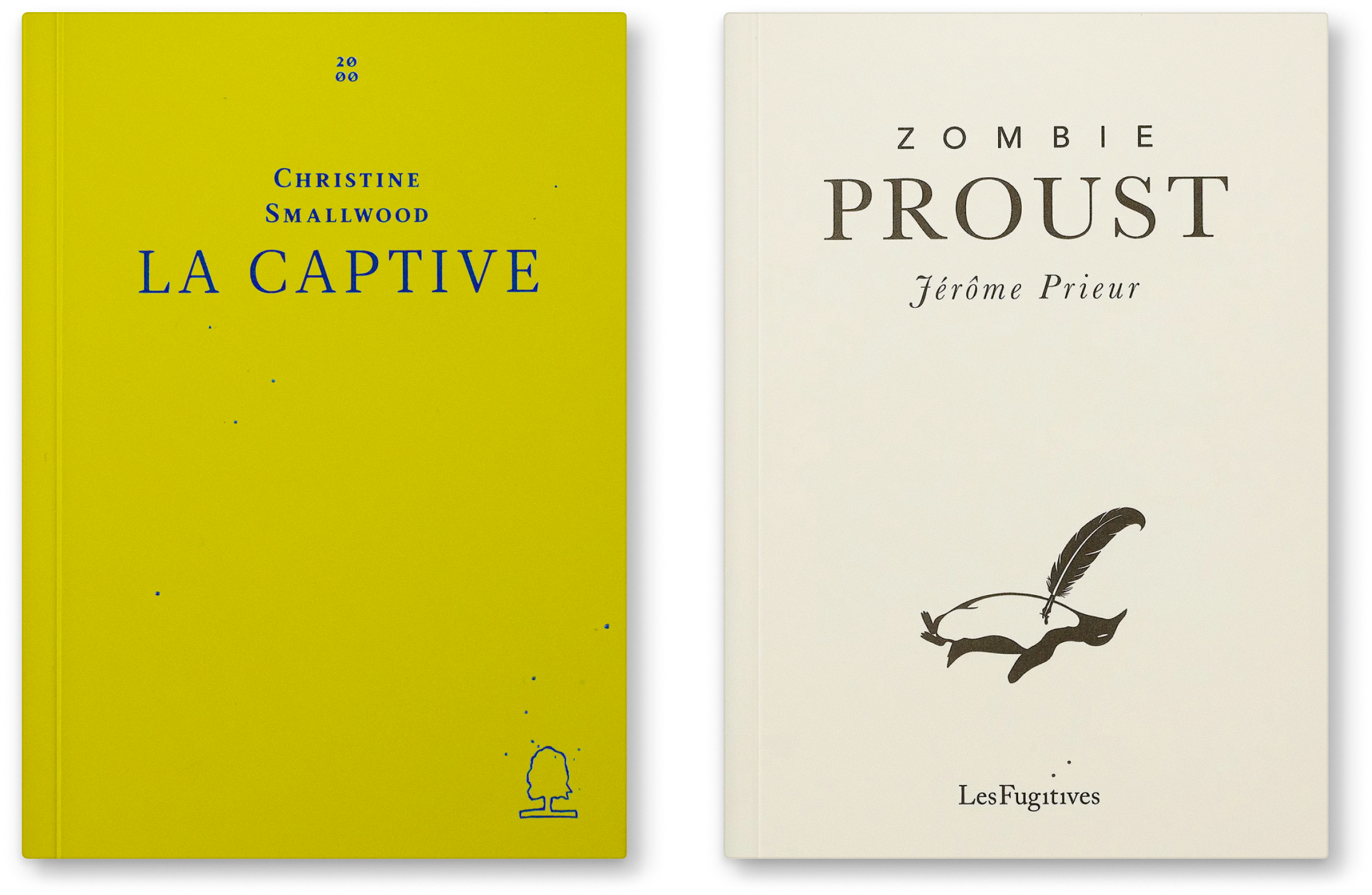
I’ll be honest. Akerman’s La Captive an extremely slow-moving film about my least favorite volume of Proust. And yet. I felt this irresistible urge to buy the literary critic Christine Smallwood’s La Captive, a book-length essay about the film:
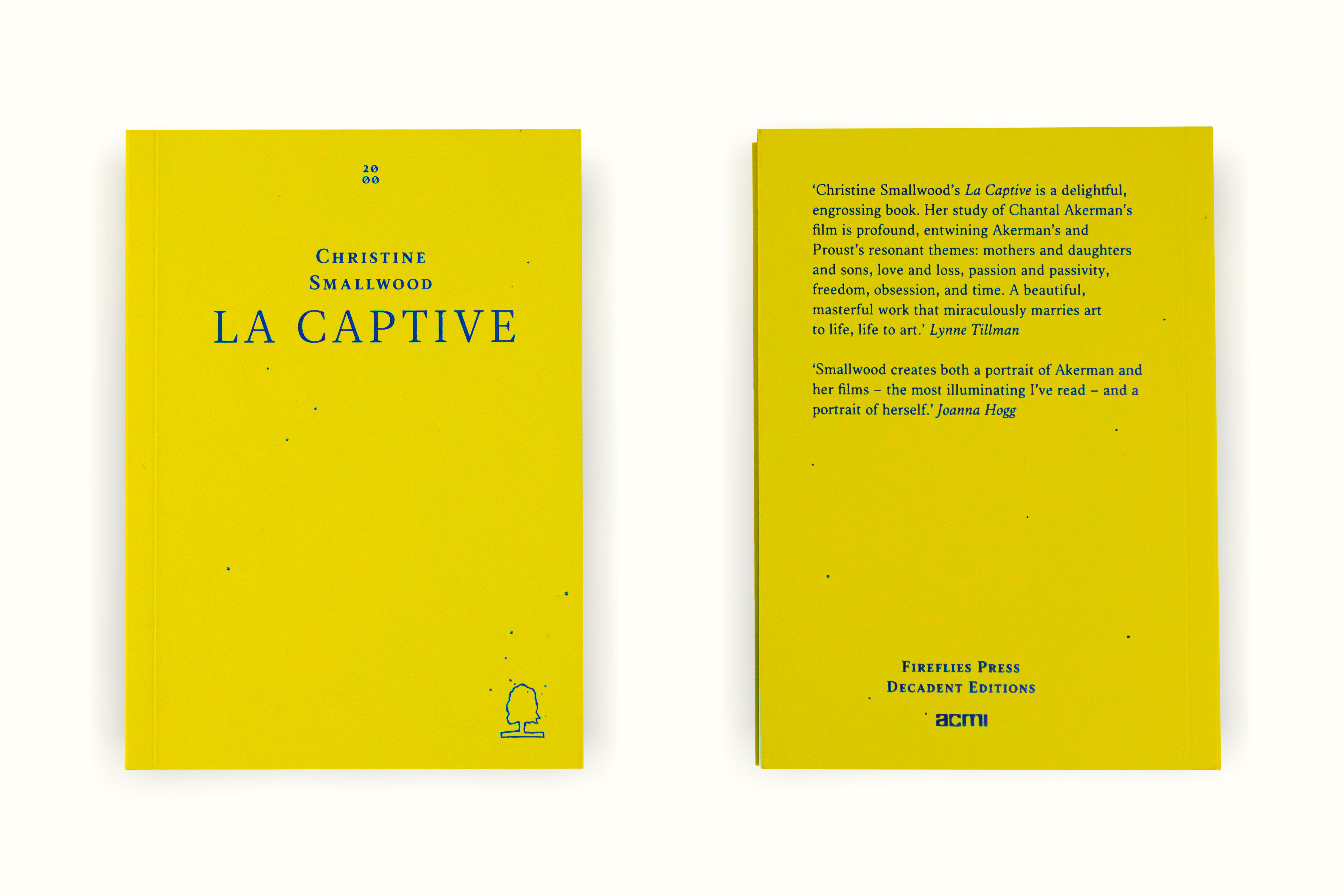
Smallwood is one of the best literary critics working today, and reading La Captive was such an invigorating experience—as soon as I finished it, I rushed off to Goodreads to type out a 720-word review (on my phone, even!) about it:
Proust's La Captive/La Prisonnière is claustrophically inert; its central concern is the protagonist's jealousy and possessiveness over his lover Albertine (one of literature's most memorable bisexual characters). Akerman's adaptation depicts this beautifully; scenes are shot in clearly delinated, contained spaces: hallways, richly colored bedrooms, inside luxurious cars. Smallwood's essay on Akerman's adaptation, in turn (we're now two degrees removed from Proust, though it's worth saying that Proust, given his obsession with involuntary memory, often seemed to be two degrees removed from himself) offers gorgeous textual renderings of Akerman's filmography…
I like that Smallwood doesn't flinch away from writing about money, and motherhood, and the drudgery and indignity and labor of it—and that makes her the perfect critic for Akerman…[who] understands that money—earning it, saving it, spending it—characterizes life just as much as making art does, and that it, therefore, can be the subject of artistic work as well.
Akerman’s films accomplish something counterintuitive and remarkable: they turn the boring parts of life into an artistic experience. This quality is beautifully expressed by Polly Alea, whose recent newsletter on films where nothing happens is a wonderful description of Akerman’s appeal:
I leave the cinema or turn off a film with the feeling that nothing really happened. No one achieved anything, there was no turning point, no scene that could easily be identified as “the most important”…
Over time, I began to notice that it is these films that stay with me the longest. Not because they told me something, but because they allowed me to spend time in someone else’s time. Without haste, without climax, without the need for closure. “Nothing is happening” then ceases to mean absence – it becomes another form of presence, less spectacular but more demanding.
Smallwood’s tiny, bright book on Akerman (and on Proust, of course) ended up being one of my favorite reads. And if you’d like to read more of Smallwood’s work—I’m particularly fond of her Bookforum review of the French lesbian writer Constance Debré’s autofiction; and an earlier Harper’s Magazine essay asking what the whole point of literature is, and whether novels still matter in contemporary life. The answer, for me and for Smallwood, is yes:
We read with our whole selves, and reading helps us discover who we are. We are always in the way, influencing and interpreting as we go. Our consciousness is secret—we have to ask other people, “What are you thinking?” just as we ask them…“What are you reading?”—but it is never really alone. It’s a busy interchange of memory, imagination, experience, and text…
What I know is that on the nights when I force myself to open a book, I feel like a person, an individual engaged in an activity at once secret and communal, rather than a receptacle of mass information.
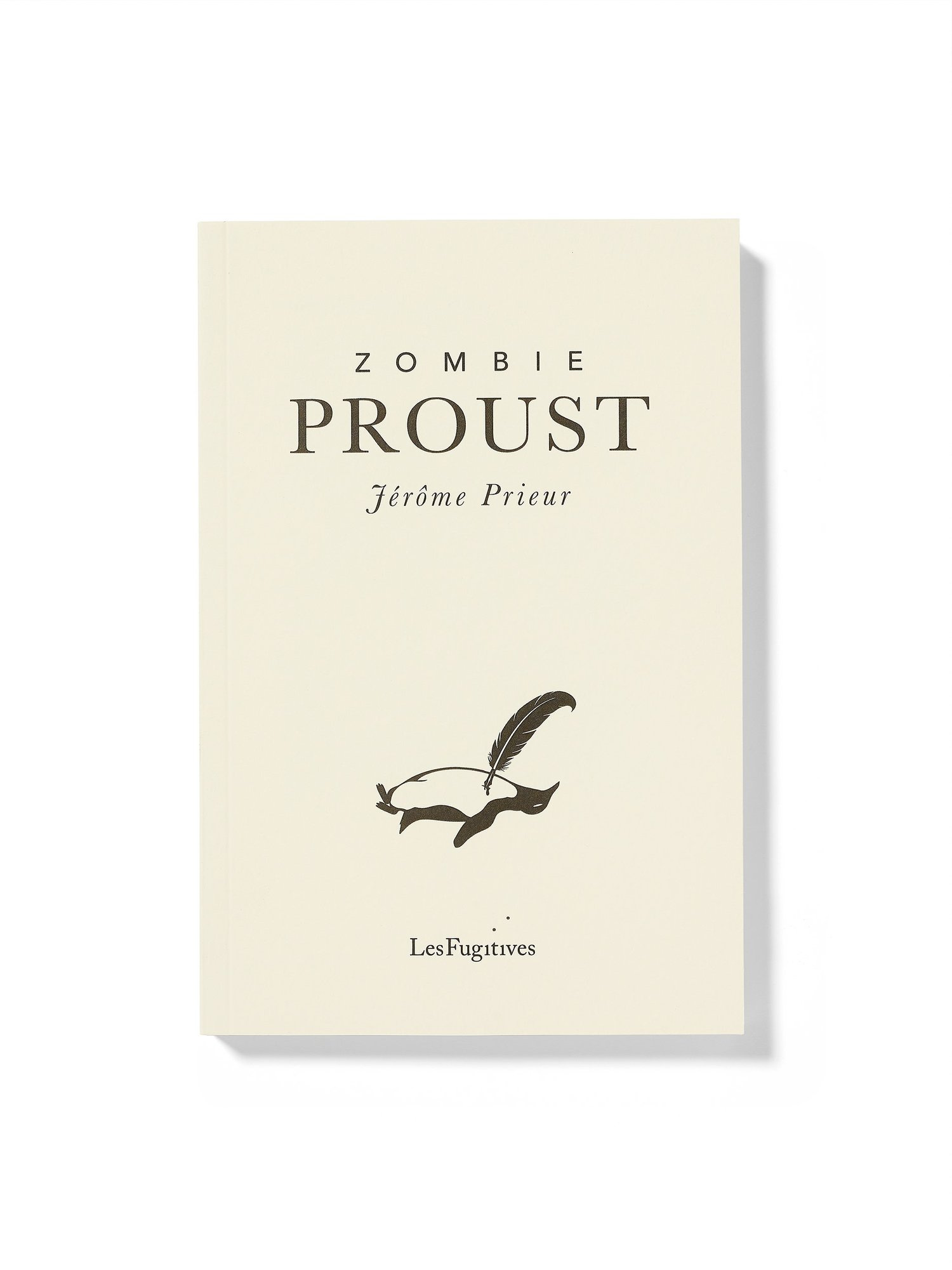
The other Proust-extended-universe-content I read (calling it ‘content’ is feeling increasingly disrespectful—let’s say Proust-extended-universe-literature) was an impulse purchase: the French filmmaker and writer Jérôme Prieur’s Zombie Proust, translated by Nancy Kline. The book has 72 titled vignettes (‘Boulevard Hausmann’, ‘Waves from the Past’, ‘Scents’, ‘Céleste Appears’, ‘The Mist of Fumigations’) that narrate scenes from Proust’s life and death. It’s an elliptical kind of biography, one that proceeds through images and associations instead of linearly organized facts.
Zombie Proust is deeply evocative and beautiful. Here’s one of my favorite vignettes:
The End of the World
In the summer of 1922, an American scholar once again announces that the end of the world is imminent. A reporter for the daily newspaper L‘Intransigeant asks several celebrities of the moment what they would do if this time it were true.
‘I think life would suddenly seem delicious to us,’ answers Marcel Proust. ‘Just imagine how many projects, travel plans, passions, areas of study it – our life – holds in suspension, invisible to us in our laziness, which, assured of a future, continually postpones them. But should all that threaten to become impossible forever, how beautiful it would become again…And yet we shouldn’t require a cataclysm to love life today. It would have been enough to reflect that we are human and death may come tonight.’
It is my humble opinion that, for the true Proust freaks, Prieur’s book is an essential addition to your bookshelf. And all of us, I think, can learn from Proust’s beautiful exhortation: We shouldn’t require a cataclysm to love life today.
For even more on Proust—

My ongoing obsession with Chinese philosophy
In my January newsletter, I proposed that a practical, useful form of Chinesemaxxing in 2026 might be to…read more Chinese philosophy. It helped that my friend Jules (who, earlier this year, wrote a particularly charming manifesto for literary it boys everywhere) gave me a copy of one of the great Chinese philosophical works: Zhuangzi, one of the canonical texts of Daoism.
I have spent the last 3 months completely obsessed with the Zhuangzi. Everyone I’ve gotten dinner with has heard me talk about it. All of my groupchats have had quotes inflicted onto them. (And I bring it up in my Dialectic episode with Jackson Dahl!) I can’t help it—the Zhuangzi is a relentlessly humorous and ironic and entertaining philosophical work, especially in Brook Ziporyn’s translation.
It’s always funny to read a great, classic work and realize: this is why it’s a classic! This is why it’s been read for centuries! As the designer (and covertly brilliant karaoke star) Ryo Lu said:

The Zhuangzi is a book that rewards rerearding. But it also rewards a dive into the secondary literature! After finishing it, I picked up a copy of Hans-Georg Moeller and Paul J. D’Ambrosio’s Genuine Pretending: On the Philosophy of the Zhuangzi, published by Columbia University Press (and another recommendation from Jules).
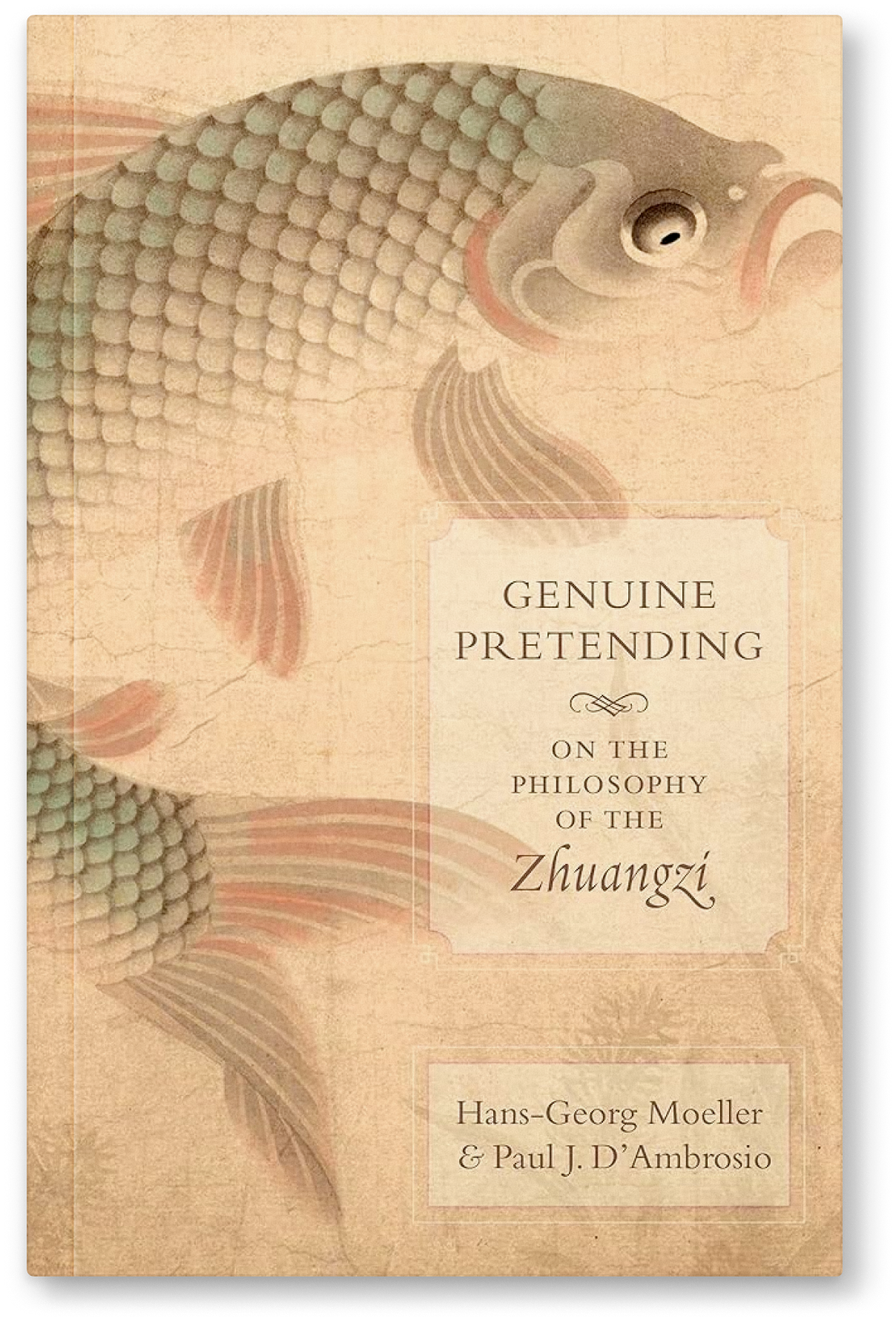
I was excited by Moeller and D’Ambrosio’s monograph because I had this vague, half-formed feeling that the Zhuangzi seemed particularly well-suited to our chaotic time, and I wanted to know how academic philosophers interpreted it!
The Zhuangzi was largely written during China’s Warring States period (476–221 BCE), and many of the stories in Zhuangzi describe how people should act in politically tumultuous times. And indeed, the introduction to Genuine Pretending notes:
We approach the Zhuangzi as a sometimes biting and provocative sociopolitical critique of its times…[and an] expression of a subversive existential mode that allows one to better endure or even to thrive in adverse circumstances…This text, among other things, advises against the common human tendency to develop an inflated ego in reaction to success—or to lose confidence in response to failure…For the sake of maintaining sanity, the Zhuangzi undermines rigid beliefs, judgments, preferences, and dislikes by fostering a humorous attitude toward the world and, in particular, toward oneself.
Genuine Pretending makes an excellent case for the continued importance of the Zhuangzi, and the authors connect its ideas to questions of filial piety versus irreverence; socially-prescribed roles versus playful autonomy; authenticity versus performativity. (The latter topic is also explored in another book by Moeller and D’Ambrosio, You and Your Profile: Identity After Authenticity. If you’re interested in reading this as well, please reach out!) And they emphasize the importance of spontaneity—and the lighthearted skillfulness that comes from being attentive and responsive to the present.
Genuine Pretending also has that particularly endearing quality of academic writing: the occasional, overly-formal phrase. There’s a passage where Moeller and D’Ambrosio discuss the Daoist perspective on uselessness and stupidity:
The wisdom of stupidity has been a perennial issue in Daoism…As Christian Schwermann (2011) has shown in a most meticulous study, stupidity became an important issue in Chinese intellectual, political, and cultural history.
Essays
I’ll close with 3 essays about anti–anti-work (from one of my new favorite essayists!), developing a creative identity, and how AI is changing the music industry—for better or worse:
The leftist case for loving your job. I’ve texted 3 different friends this week about Martin Dolan’s “Clocked Out” for The Point, which gently rebukes the anti-work, bullshit jobs left (which assumes that all jobs are fake and that trying hard is vaguely embarrassing at best, complicit at worst). “I’m frustrated,” Dolan writes, “by how these left thinkers seem implicitly to dismiss the possibility of fulfilling work altogether—at least until after we’ve gotten rid of capitalism.” After a discussion of the American philosopher and MacArthur fellow Elizabeth Anderson’s work, Dolan suggests:
For today’s 23-year-old college grad, Anderson’s notion of the progressive work ethic might just be more compellingly “countercultural” than yet another broadside against the absurdity of having a job under capitalism. Her ideas channel the structural frustration of the bullshit-jobs left while holding on to the notion that work can be more than a scam or a chore. It grants permission to groan about bad, unfulfilling work without conceding that all work is always bad.
Dolan is an exceptional writer and thinker—I also loved “My Dumb Journey Through a Smartphone World” (questioning the value of dumbphones and retreating from the internet, for The Nation) and his “elegy for the indie games renaissance” (for Strange Matter).
What is writing good for? What does it mean to be a “writer”? Longtime readers will know that I’m very invested in writing, researching, and thinking across the “two cultures”—STEM and the arts/humanities. The physicist and essayist Michael Nielsen’s “Developing creative identity” is an exceptional work in this genre: he begins by asking what it means to work across disciplines (and the insecurity/anxiety that can result), and what it means to write across disciplines. He then discusses a number of more conventionally STEM-coded writers (Charles Darwin, Albert Einstein) and more humanities-coded writers (Vladimir Nabokov, Robert Caro) to distill some useful insights about how different people use writing to explore and persuasively convey their ideas:
As we develop new means of understanding and explaining the world, we develop new literary forms. But those means of understanding and explaining emerge only slowly, as do the forms. [The ancient Greek philosopher] Empedocles…was using the medium he knew in order to develop his understanding. But he was also modifying and developing the medium to support new kinds of thought and new representations for that thought. Viewed this way, writing is a mutable, extensible tool that can be used to gradually expand the ways we make sense of the world. It evolves in concert with corresponding activities in the physical world – ways of observing and intervening, ways of making sense.
It’s hard for me to convey how expansive this essay is—I recommend reading in full! And don’t skip the footnotes:
No one is talking about it; (almost) everyone is doing it. For Rolling Stone, Nathan Brackett (who also writes the weekly music/tech newsletter Stems) wrote about how “behind closed doors, AI-powered tools are causing profound shifts in how music is being made at all levels of the industry.” Longtime professionals are experimenting with AI for stem separation, mixing, and more:
Jay-Z’s longtime producer, DJ, and engineer, Young Guru, says it’s become common for hip-hop producers to make funk and soul samples out of AI, rather than license original music or hire musicians. Guru guesses that “more than half” of sample-based hip-hop is being made this way now. He still pays for samples or hires musicians to interpolate them, but producers who don’t have the budgets or inclination now have a shortcut. “They’re getting really good at prompting now,” he says. “Where before it was just ‘Give me soulful 1960s whatever,’ now it’s ‘Give me 1960s music as if it was recorded in Motown and this person wrote it,’ or ‘Give me 1970s music as if it was recorded at Stax if this person wrote it and this person played bass’”…Of course, for every task that AI streamlines, there might be someone on the other end who isn’t paid anymore: a demo musician or producer, an assistant engineer who helps with mixes, a studio owner renting time, maybe a Seventies songwriter living off of licensing fees. Nashville native Chapman says he’s hopeful that the doors AI opens to amateurs will lead to a boom for musicians and studio owners down the road. But for now, “there are less sessions happening,” he says. “It’s hurting the demo community.”
I’m writing this a little past midnight in London, and desperately hoping that this time, I’ll manage to send a late-night newsletter without typos. I’m a little tired, but mostly happy. It’s a beautiful feeling to stay up late with an exciting new book (which I do far too often, still); and it’s exciting to talk about them with other people.
Thanks for reading, as always—and let me know in the comments (or by replying to this email!) if any of these books catch your interest. I’d also love to hear what you’ve been reading as well.
(And if you buy any of these books: consider getting them from your local independent bookstore! (Some of them will even order books for you—I did this all the time with Dog Eared Books when I lived in San Francisco.)
It is my personal opinion that, out of of all the recreational drugs a young woman in a metropolitan area can encounter, pot is the most annoying one.
The typeface used for the Whole Earth Catalog cover, Windsor, is indelibly associated with the 1970s. As the designer and professor Jarrett Fuller wrote:
Despite its distinct visual characteristics — the extra-wide M's and N's, the curious curve of the lowercase 'f' — Windsor is surprisingly versatile and can be found in a curiously diverse range of applications, reaching peak popularity in the late sixties and early 70s. Stewart Brand used it for the masthead of his Whole Earth Catalog, television shows like The Price is Right, The Goldbergs, 227, and All in the Family have used it in their opening credits…Nightclubs like New York's Max's Kansas City and Minneapolis's First Avenue and 7th St have used it in their logos…It's a popular book cover typeface where it's employed on a range of covers from Joseph Conrad's 1950 edition of Heart of Darkness to the 1971 edition Jack Kerouac's Scattered Poems.
In 2017, Fuller lamented that ‘For all its versatility…Windsor is largely forgotten in the canon of design history.’ Why is that? It’s a little idiosyncratic, earnest, weird, and is the opposite of timeless. In an essay for the Font Review Journal, Bethany Heck observed that:
Windsor is frequently used as visual shorthand to signal “this is about the 70’s.”
But perhaps that’s why the typeface has had something of a revival in the last few years. By 2021, the novelist Sophie Kemp suggested that Windsor was 2021’s favorite font. (Worth noting: Kemp is also mentioned in the acknowledgments for Levy’s Flat Earth.)
I should say that Sophie has excellent literary taste—she was the first person to recommend Yáng Shuāng-zǐ’s Taiwan Travelogue to me, which was shortlisted for the 2026 International Booker—and we’re not too different as readers!
Which means that Balle’s On the Calculation of Volume is a truly polarizing read! Catherine Lacey loved it. Henry Oliver loved it. Naomi Kanakia found it ‘intensely boring.’
There's a big article on On the Calculation of Volume in the latest London Review of Books, generally favourable
My "Intro to Asian Philosophy" professor's syllabus had us buy and sample Mencius (the book), The Daodejing of Laozi (trans. Ivanhoe), The Bhagavad Gita, and a healthy dose of Buddhist works because he was also a local sangha teacher. These included The Holy Teaching of Vimalakīrti (Thurman) and The Sutra of Hui-Neng (Cleary.)
I still have those (badly neglected) copies because I think Asian philosophy is one of the most slept-on intellectual pursuits of the Anglosphere today, though we're slowly realizing what we're missing.