

I’ve been reading very little this week and reconciling with nature instead—swimming, cycling, and applying large quantities of sunscreen—but I’m here to share 3 announcements and 5 recent favorites:
Everyone wrote about taste this year, including me
First—my essay on taste, Silicon Valley, and AI is now out! You can read “Why We Like Things” online or in print, as part of Asterisk’s Work issue (along with work from the social scientist Kevin Munger, economics writer David Oks, and others).


I was lightly terrified about whether I could pull off this essay, for two reasons:
It’s the first magazine piece I’ve done that wasn’t a book or art review. Reviews are nice because you can relax into the form a little; for a book review, for example, there’s usually a paragraph where you’re supposed to explain the work being reviewed and who wrote it; and you need to do some deft plot summary (useful to those who have and haven’t read the book); and you need to perform some analysis…but writing an essay fully powered by the momentum of my own thesis was quite different!
And because taste was the buzzword of the year, I was regularly confronted with new essays, posts, and podcasts about the concept—often from writers I admired, often using the same reference points (Bourdieu, Sontag, etc). I wanted to see if I could write something that added to the discourse and felt original in some way, while also acknowledging a much longer lineage behind the topic.1
But I’m really happy with the outcome. And I was really touched to see my essay mentioned in one of Haley Nahman’s recent newsletters (especially since so many of my friends read and love Maybe Baby!)
Come see me in LA for an evening conversation about balancing one’s inner life and public presence
Second—in the process of working on my taste essay, I began to feel that I could only pull off the essay by retreating inwards, creating a buffer between me and the external world. Concretely, this meant that I shielded myself from social media, rarely posted, didn’t go out. And during my self-imposed retreat, I began thinking about how to balance one’s inner life and public presence. Many of the people who champion logging off…don’t. Because there’s a cost to doing so, if you want your work to be seen and read and shared.
These are questions I’d love to think about with others. On Thursday, I’m doing an event at Plot 田 (a bookstore and community space for creative inquiry in Chinatown Los Angeles) called Depth or Surface. We’ll discuss how one’s work can be helped or hindered by all the contemporary pressures to…post on social media! Build an audience! And do all these things which seem necessary for a creative career in the 21st century, but also might have a distracting (at best) and distorting/degrading (at worst) impact on the quality and integrity of one’s work.
I’d like this to feel very conversational—I’ll share some ideas and would love to hear from others! And I’d like us to end the evening with a more coherent sense of what level of interiority/exteriority is aligned with our own values, and what will help us do our best work. If you’re in LA, you can get tickets here for $15.
I’m particularly excited to do this at Plot 田, which is a beautiful community space and bookstore that the artist Alice Yuan Zhang opened last year. It’s since become a place for artists, designers, writers and makers to gather.
Previous events have included a bamboo lantern workshop, talks on Japanese-American style, communal housing projects in Vienna, a listening session for Taiwanese field recordings…it’s really an amazing range. It makes me sad to not live in LA—and envious of everyone who can regularly go to events here!


My other plans in LA—seeing Yoko Ono’s retrospective at The Broad; a screening of Richard Linklater’s Dazed and Confused; and the Machine Dreams: Rainforest exhibition that was recently reviewed by Claudia Ross. (And Iz, one of the organizers of FWB Fest, has urged me very, very strongly to visit Sonoratown for tacos.)
I’m participating in the New Museum’s incubator for art/code/technology this year!
Third—from September onwards, I’ll be participating in NEW INC, the New Museum’s incubator for new media, art, design, science, and technology. I’m part of the Art & Code track, along with 14 other artists, designers, technologists, and community builders:
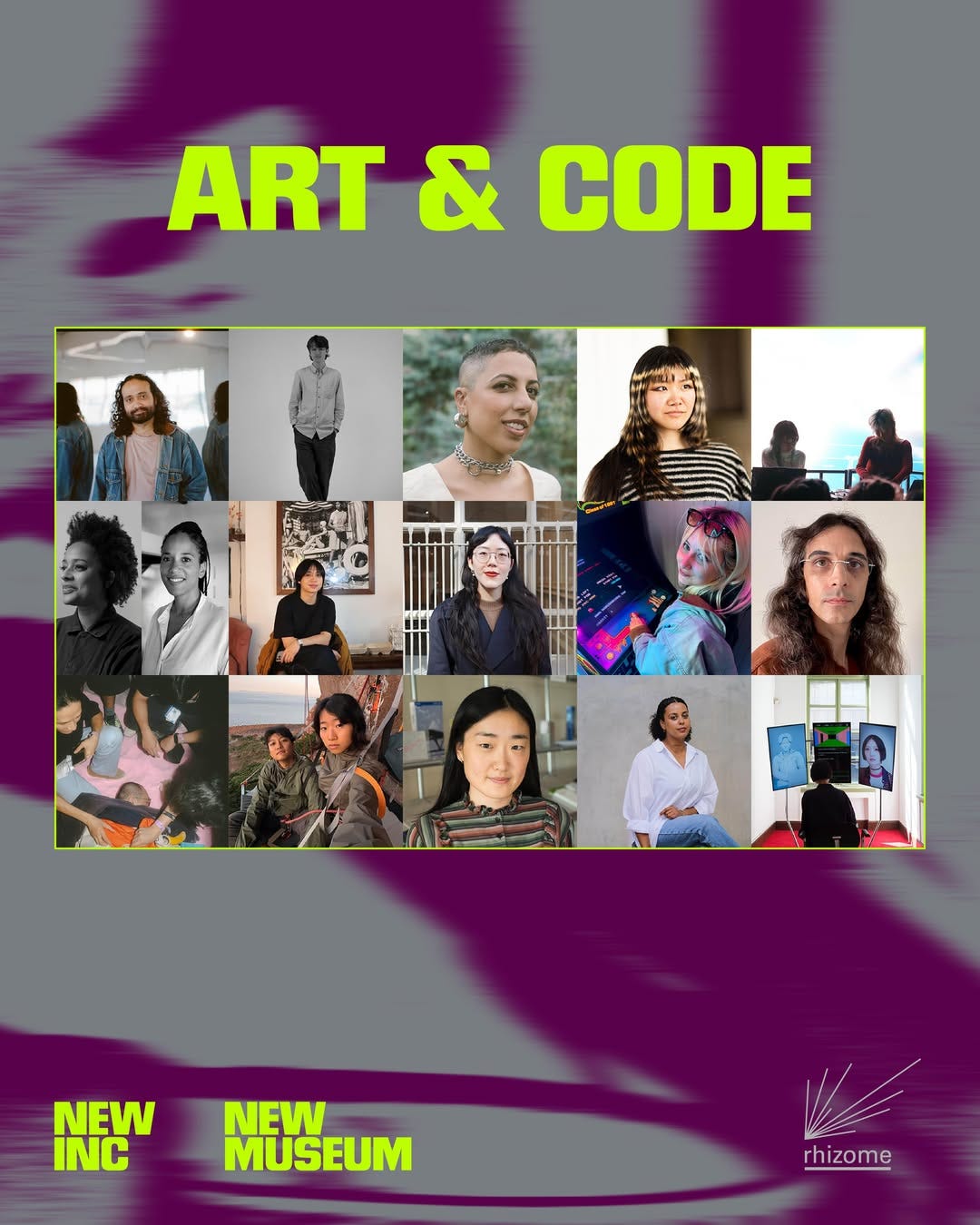
I’m really thrilled to be a part of NEW INC. For the past two-ish years, I’ve spent many of my evenings and weekends writing about how culture shapes software, and how software shapes culture. I’m excited to push my practice further and see what interfaces and essays will result. More on this in a future newsletter!
And I’m thrilled to have such a good reason to move back to the US. I’ve spent five-ish years in London and will miss the city enormously. Swimming in Hampstead Heath! Sheltering from the rain in the Tate Modern’s Turbine Hall! Taking the Victoria line! Wearing “jumpers” and “trainers” instead of sweaters and sneakers!
But I also feel that, as an Asian-American, my true homeland is…America…and I’m excited to be back.
Five recent favorites
Art Nouveau! ✦✧ Alternative to what? ✦✧ What devotion looks like ✦✧ Shoes I’m not allowed to buy (from Tokyo Design Studio) ✦✧ A kinetic and exuberant song for the summer
Art Nouveau! ✦
My camera roll is 80% photos of books I’m reading (that’s how I remember what to quote in my capsule review newsletters!) and 20% posters and street signage. During a very brief stopover in San Francisco, I walked past this incredible Art Nouveau lettering for a hotel:
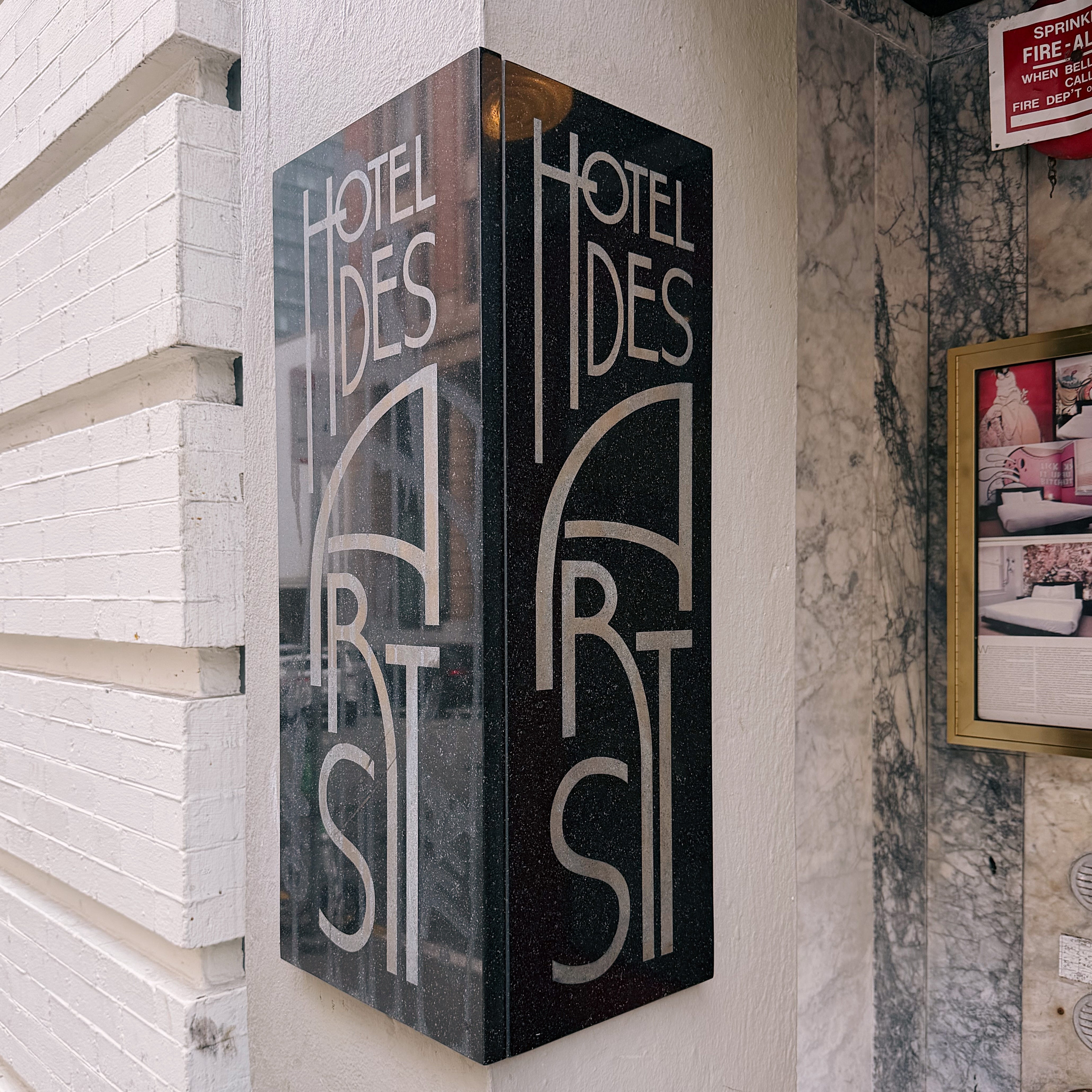
The last time I wrote about Art Nouveau lettering was in 2024, at the bottom of a newsletter about the architects Alvar and Aino Aalto—

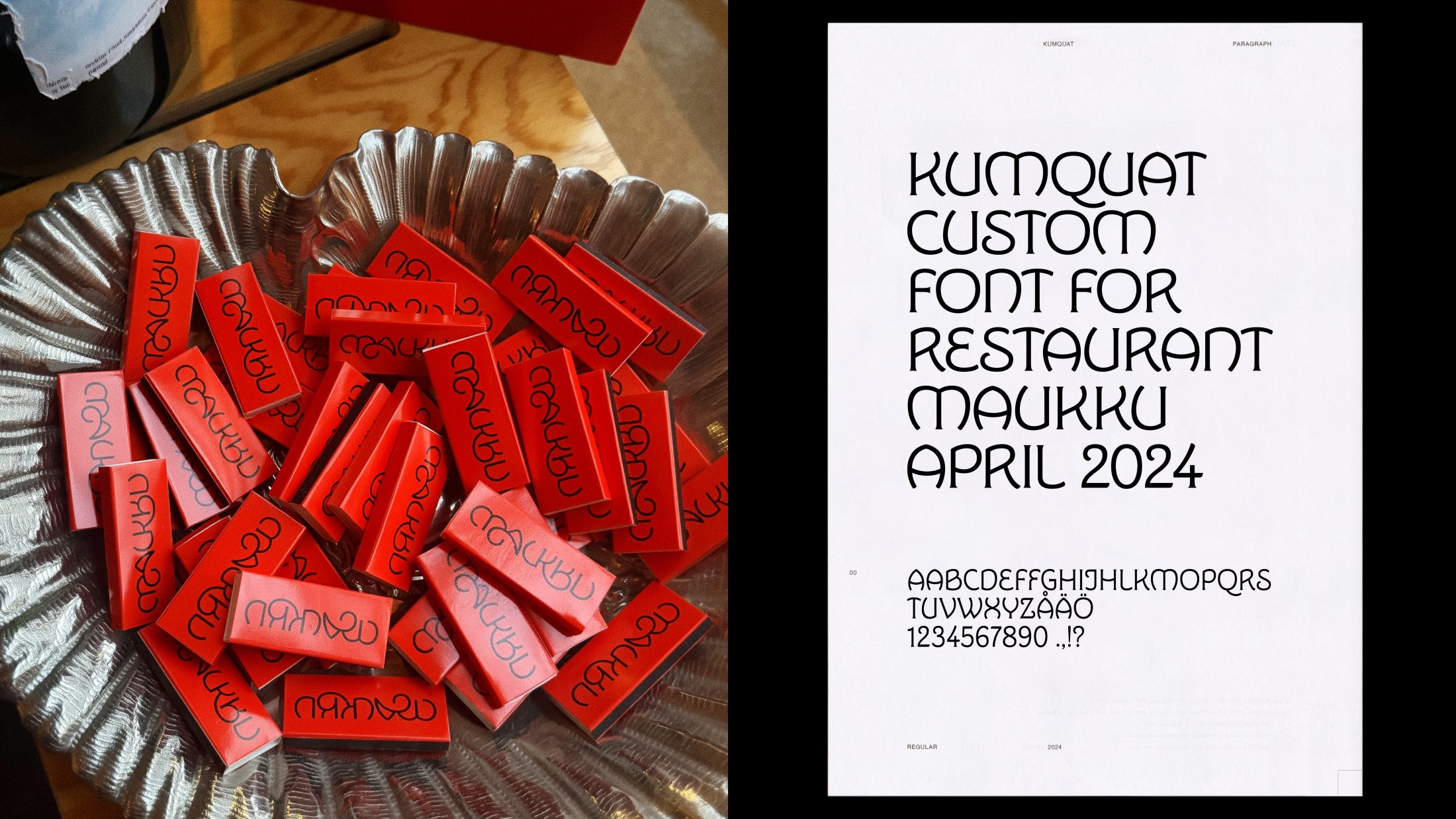
—where I mentioned the logo for the Helsinki restaurant Maukku. It’s a custom typeface designed by Aleksi Tammi and Céline Jouandet:
Alternative to what? ✦
I’ve started describing personal canon as a newsletter about how to live the life of the mind in the 21st century. The Life of the Mind is, in fact, the name of a novel by the literary critic Christine Smallwood, which describes how painfully difficult it is to carve out a life organized around ideas, learning, research, and writing within the contemporary university.
But there are other ways to pursue this life, and other educational forms that can facilitate it. The researcher and former university professor Shannon Mattern has an Are.na channel devoted to para- and extra-institutional schools. It includes places like the School for Poetic Computation, where I’ve taken 2 classes; it also includes ultralight school, where I co-taught a class this summer.2
So I enjoyed reading the artist Anton Vidokle’s discussion of alternative arts education in e-flux, where he writes:
One way to understand the proliferation of alternative education is through a broader loss of confidence in institutions. This is not limited to schools and universities; it extends to museums, public agencies, political institutions, and nation states, and to their ability to represent collective interests or provide continuity…
Alternative arts education is often described by what it removes: tuition, degrees, admissions criteria, fixed curricula, permanent faculty. But removing these things does not remove the institution…Rejecting formal hierarchies does not prevent informal authority from supplanting them. A free school can still be very difficult to enter.
The word “alternative,” as Vidokle points out, is a “complicated” one. But for those interested in shaping their own extra-institutional education (or facilitating other people’s educations!) it’s helpful to dig into those complications. Alternative isn’t intrinsically better. But it can be.
What devotion looks like ✦
I always love Quanta’s profiles of mathematicians, and Natalie Wolchover’s article about Hong Wang, who won the Fields Medal this year, is a charming look at Wang’s devotion to her work:
When she isn’t traveling, Wang works with the devotion and discipline of a cloistered nun or elite athlete. “She’s crazy into math,” said Shukun Wu of Indiana University, a collaborator. “She’s definitely one of the most dedicated people I’ve seen.” She denies herself time-consuming indulgences like reading books or having a dog, though she does make time for friends, yoga, and early-morning walks to see the dogs at Washington Square Park, which all help relieve the stress and feelings of self-doubt that, for her, can accompany mathematical research.
But it turns out even high performers like Wang can wistful about what they’re giving up:
Wang said that at the moment she doesn’t want to get too invested in solving any particular problem…She worries about falling behind, and still believes that she must put in more hours than her colleagues to be as good as they are. When challenged on this — everyone considers her extremely talented — she seemed genuinely surprised and pleased…
Wang is excited for what is to come. Another hard problem, reserved for the future, is how to feel confident as a mathematician while holding space that doesn’t center around math. Wang is encouraged that Guth, her adviser, finds time to read for pleasure. “I always wish that I could come back to that time when I just feel like I had infinite time to read,” she said. “I think that time was really nice.”
Shoes I’m not allowed to buy, from Tokyo Design Studio ✦
My latest international move has made me painfully aware of how much I own—books I still haven’t read, shoes I rarely wear. I definitely shouldn’t be shopping right now! But I really wish I could justify buying these New Balance x Tokyo Design Studio trainers sneakers:


They seem really ideal for a gorpcore-y outfit, and a little more unexpected than Nike Air Rifts.
A kinetic and exuberant song for the summer ✦
When CFCF’s memoryland came out in 2021, I fell in love with the whispered, barely-there vocals that open the second track, “Life is Perfecto,” while a beat slowly assembles and gathers velocity over the next seven minutes It was the first song that Mike Silver wrote for the album, and in an interview with Stereogum, he said that he was inspired:
after a viewing of Hou-Hsiao Hsien's iconic film Millennium Mambo…It was the catalyzing inspiration for the album, and I wanted to do justice to its universal themes of alienation from one's own identity amid the turbulence of youth in a globalized metropolis on the cusp of the millennium.
memoryland was an album for slow swaying, giddy bursts of trance-y energy, and profound nostalgia for the cheerful linearity of electronica. And such a capacious album! When the critic Shawn Reynaldo reviewed memoryland for Pitchfork, describing it as “charming” with “an element of kitsch,” Silver responded by saying:
honestly, this album was conceived as a “7”—i wanted it to be kind of bloated, overreaching, and not without its weaknesses
CFCF’s latest album, L.U.V., speeds things up a little. I’ve been listening to it all summer and particularly “Life Illusion,” which—I’ll admit—is not particularly lyrically profound, but it is incredibly and unremittingly fun. The whole album is unrepentantly high-energy and poppy and showy. Listen to this in the sunshine!
Thank you for reading—I hope I’ll see some of you in LA, and perhaps some more people in NYC this autumn! And now I’m back to immerse myself in sunlight (instead of curling up indoors by my laptop charger).
By “lineage,” I of course mean people like Pierre Bourdieu, whose Distinction: A Social Critique of the Judgement of Taste came out in 1979. (It was translated into English in 1984).
But I’m also thinking about all the conversations about taste that happened just two years ago, when the writer/investor/founder Anu wrote about how “taste is eating Silicon Valley” in her newsletter; and when the Dirt Media CEO Daisy Alioto gave a talk about the emerging “taste economy” at FWB Fest 2024.
I’ve taken two classes at SFPC: Dark Matters (taught by American Artist and Zainab Aliyu) and Let’s Play: Wayward Sentences (taught by Kameelah Janan Rasheed). Rasheed is one of those extravagantly, irreducibly expansive artist-writer-thinkers always offering up new ideas and references and works to explore. I still remember that, in the first Wayward Sentences class, she showed us a quote from Clarice Lispector’s Água Viva—
What am I doing in writing to you? trying to photograph perfume.
—and after the class, I checked out a copy from the San Francisco Public Library (this was 2024, when I was still living there). It’s a very slim book; you can finish it in a day. And it’s full of Lispector’s distinctively strange, evocative, passionately abstracted prose:
Let me tell you: I’m trying to seize the fourth dimension of this instant-now so fleeting that it’s already gone because it’s already become a new instant-now that’s also already gone. Every thing has an instant in which it is. I want to grab hold of the is of the thing. These instants passing through the air I breathe: in fireworks they explode silently in space. I want to possess the atoms of time. And to capture the present, forbidden by its very nature: the present slips away and the instant too…
Only the act of love—the limpid star-like abstraction of feeling—captures the unknown moment…during love the impersonal jewel of the moment shines in the air, the strange glory of the body, matter made feeling in the trembling of the instants—and the feeling is both immaterial and so objective that it seems to happen outside your body, sparkling on high, joy, joy is time’s material and the essence of the instant.
Please information send me
Please information send me